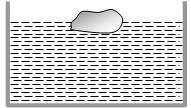
A body floats in a liquid contained in a beaker. The whole system as shown falls freely under gravity. The upthrust on the body due to the liquid is
IIT 1982, Medium


Download our appand get started for free
Experience the future of education. Simply download our apps or reach out to us for more information. Let's shape the future of learning together!No signup needed.*
Similar Questions
- 1What will be the nature of flow of water from a circular tap, when its flow rate increased from $0.18\, L / min$ to $0.48\, L / min$ ? The radius of the tap and viscosity of water are $0.5\, cm$ and $10^{-3}\, Pa s$, respectively.View Solution
(Density of water : $10^{3}\, kg / m ^{3}$ )
- 2Two identical cylindrical vessels with their bases at same level, each contains a liquid of density $d$ . The height of the liquid in one vessel is $ h_1$ and that in the other vessel is $h_2$ . The area of either base is $A$ . The work done by gravity in equalizing the levels when the two vessels are connected isView Solution
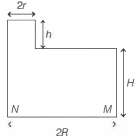
- 3A cylindrical vessel of base radius $R$ and height $H$ has a narrow neck of height $h$ and radius $r$ at one end (see figure). The vessel is filled with water (density $\rho_w$ ) and its neck is filled with immiscible oil (density $\rho_0$ ). Then, the pressure atView Solution
- 4A streamlined body falls through air from a height $h$ on the surface of a liquid. If $d$ and $D(D > d) $ represents the densities of the material of the body and liquid respectively, then the time after which the body will be instantaneously at rest, isView Solution
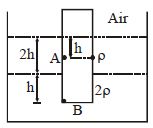
- 5A cylinder stands vertical in two immiscible liquids of densities $\rho$ and $2 \rho$. The height of two liquids are shown. Find the difference in pressure at point $A$ and $B$View Solution
- 6There is a hole in the bottom of tank having water. If total pressure at bottom is $ 3 atm$ ($1 atm = 10^5N/m^2$) then the velocity of water flowing from hole isView Solution
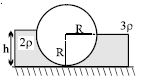
- 7In the figure shown, the heavy cylinder (radius $R$) resting on a smooth surface separates two liquids of densities $2\ \rho$ and $3\ \rho$ . The height $‘h’$ for the equilibrium of cylinder must beView Solution
- 8A liquid drop of mass $m$ and radius $r$ is falling from great height. Its velocity is proportional to ............View Solution
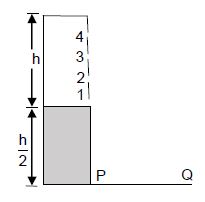
- 9A cylinder of height $h$ is filled with water and is kept on a block of height $h / 2$ . The level of water in the cylinder is kept constant. Four holes numbered $1, 2, 3$ and $4$ are at the side of the cylinder and at heights $0,\ h / 4,\ h / 2$ and $3h / 4$ respectively. When all four holes are opened together, the hole from which water will reach farthest distance on the plane $PQ$ is the hole numberView Solution
- 10A piece of gold weighs $10 \,g$ in air and $9 \,g$ in water. What is the volume of cavity is ...... $cc$ (Density of gold $=19.3 \,g cm ^{-3}$ )View Solution