MCQ
The mass defect per nucleon is called:
- ABinding energy
- BPacking fraction
- CIonisation energy
- DExcitation energy
Explanation:
Nuclear binding energy can be computed from the difference in mass of a nucleus, and the sum of the masses of the number of free neutrons and protons that make up the nucleus. Once this mass difference, called the mass defect or mass deficiency, is known, Einstein's mass-energy equivalence formula can be used to compute the binding energy of any nucleus.
Early nuclear physicists used to refer to computing this value as a "packing fraction" calculation.
Generate a complete, print-ready paper with questions like this in minutes — across 16+ boards, with answer keys.
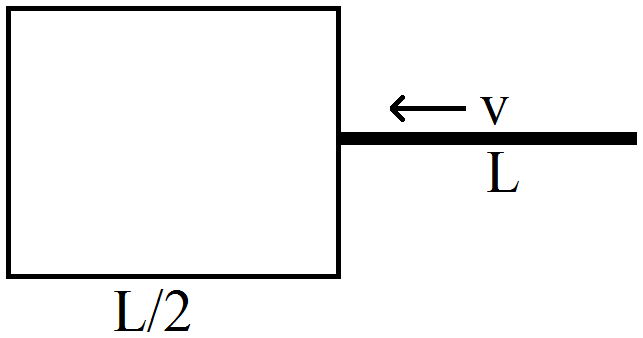
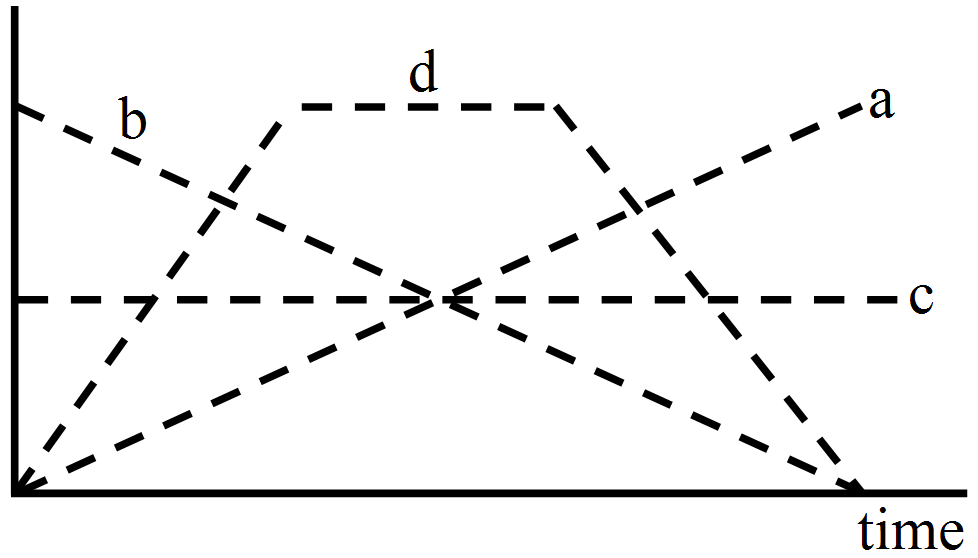
Which of the following has a negative temperature coefficient
|
(a) C |
(b) Fe |
(c) Mn |
(d) Ag |
An electron (charge q coulomb) enters a magnetic field of H  with a velocity of vm/s in the same direction as that of the field the force on the electron is
|
(a) Hqv Newton’s in the direction of the magnetic field |
|
(b) Hqv dynes in the direction of the magnetic field |
|
(c) Hqv Newton’s at right angles to the direction of the magnetic field |
|
(d) Zero |
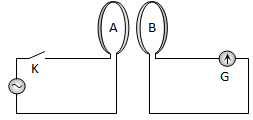
The diagram below shows two coils A and B placed parallel to each other at a very small distance. Coil A is connected to an ac supply. G is a very sensitive galvanometer. When the key is closed
|
(a) Constant deflection will be observed in the galvanometer for 50 Hz supply |
|
(b) Visible small variations will be observed in the galvanometer for 50 Hz input |
|
(c) Oscillations in the galvanometer may be observed when the input ac voltage has a frequency of 1 to 2 Hz |
|
(d) No variation will be observed in the galvanometer even when the input ac voltage is 1 or 2 Hz |