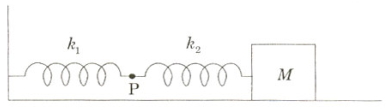
The mass $M$ shown in the figure oscillates in simple harmonic motion with amplitude $A$. The amplitude of the point $P$ is
IIT 2009, Diffcult


Download our appand get started for free
Experience the future of education. Simply download our apps or reach out to us for more information. Let's shape the future of learning together!No signup needed.*
Similar Questions
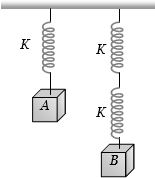
- 1The springs shown are identical. When $A = 4kg$, the elongation of spring is $1\, cm$. If $B = 6\,kg$, the elongation produced by it is ..... $ cm$View Solution
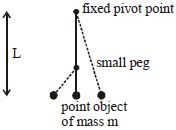
- 2A simple pendulum of length $L$ is constructed from a point object of mass $m$ suspended by a massless string attached to a fixed pivot point. $A$ small peg is placed a distance $2L/3$ directly below the fixed pivot point so that the pendulum would swing as shown in the figure below. The mass is displaced $5$ degrees from the vertical and released. How long does it take to return to its starting position?View Solution
- 3A mass $0.9\,kg$, attached to a horizontal spring, executes $SHM$ with an amplitude $A _{1}$. When this mass passes through its mean position, then a smaller mass of $124\,g$ is placed over it and both masses move together with amplitude $A _{2}$. If the ratio $\frac{ A _{1}}{ A _{2}}$ is $\frac{\alpha}{\alpha-1}$, then the value of $\alpha$ will be$......$View Solution
- 4If $< E >$ and $< U >$ denote the average kinetic and the average potential energies respectively of mass describing a simple harmonic motion, over one period, then the correct relation isView Solution
- 5A cylindrical plastic bottle of negligible mass of filled with $310\, ml$ of water and left floating in a pond with still water. If pressed downward slightly and released, it starts performing simple harmonic motion at angular frequency $\omega $. If the radius of the bottle is $2.5\, cm$ then $\omega $ is close to ..... $rad\, s^{-1}$ (density of water $= 10^3\, kg/m^3$)View Solution
- 6View SolutionThe mass and diameter of a planet are twice those of earth. The period of oscillation of pendulum on this planet will be (If it is a second's pendulum on earth)
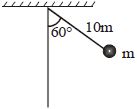
- 7View SolutionIf pendulum is released from given position find velocity of Bob when it reaches the lowest position
- 8A simple harmonic wave having an amplitude a and time period $T$ is represented by the equation $y = 5\sin \pi (t + 4)m.$ Then the value of amplitude $(a)$ in $(m)$ and time period $(T) $ in second areView Solution
- 9A particle which is simultaneously subjected to two perpendicular simple harmonic motions represented by; $x = {a_1}\,\cos \,\omega t$ and $y = {a_2}\,\cos \,2\,\omega t$ traces a curve given byView Solution
- 10The maximum potential energy of a block executing simple harmonic motion is $25\,J$. A is amplitude of oscillation. At $A / 2$, the kinetic energy of the block is $...............$View Solution