MCQ
The mass number of a nucleus is:
  • A
    Always less than its atomic number.
  • B
    Always more than its atomic number.
  • C
    Equal to its atomic number.
  • Sometimes more than and sometimes equal to its atomic number.

Answer

Correct option: D.
Sometimes more than and sometimes equal to its atomic number.
Mass number of a nucleus is defined as the sum of the number of neutron and protons present in the nucleus, i.e. the number of nucleons in the nucleus, whereas atomic number is equal to the number of protons present. Therefore, the atomic number is smaller than the mass number. But in the nucleus $($like that of hydrogen $^1H_{​1}),$ only protons are present. Due to this, the mass number is equal to the atomic number.

Need a full question paper?

Generate a complete, print-ready paper with questions like this in minutes — across 16+ boards, with answer keys.
Start Generating Free

Similar questions

27 small drops of water with equal radius and equal charge comprised to form one big drop. The ratio of capacitance of a big drop and capacitance of a small drop will be:
Identify the correct statement from the following.
The Rutherford α-particle experiment shows that most of the α-particles pass through almost unscattered while some are scattered through large angles. What information does it give about the structure of the atom?
When a photon stimulates the emission of another photon, the two photons have:
  1. Same energy.
  2. Same direction.
  3. Same phase.
  4. Same wavelength.
  5. All of the above
Two identical cells send the same current in $2 \Omega$ resistance, whether connected in series or in parallel. The internal resistance of the cell should be
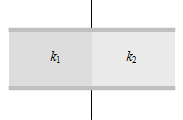
A parallel plate condenser is filled with two dielectrics as shown. Area of each plate is $A$ metre$^2$ and the separation is $t$ metre. The dielectric constants are $k _1$ and $k _2$ respectively. Its capacitance in farad will be
A ray of light is incident on the surface of separation of a medium at an angle $45^\circ$ and is refracted in the medium at an angle $30^\circ $. What will be the velocity of light in the medium
What causes chromatic aberration?
What will be the nature of equipotential surfaces due to a point charge, situated at infinity?
A spring-mass system oscillates with a frequency v. If it is taken in an elevator slowly accelerating upward, the frequency will:
  1. Increase.
  2. Decrease.
  3. Remain same.
  4. Become zero.