MCQ
The material of permanent magnet has
  • A
    High retentivity, low coercivity
  • B
    Low retentivity, high coercivity
  • C
    Low retentivity, low coercivity
  • High retentivity, high coercivity

Answer

Correct option: D.
High retentivity, high coercivity
d
(d)From the characteristic of $B-H$ curve.

Need a full question paper?

Generate a complete, print-ready paper with questions like this in minutes — across 16+ boards, with answer keys.

Start Generating Free

Similar questions

$C{H_3} - C{H_2} - CH = O\xrightarrow[{(2)\,{H^ \oplus }}]{{(1)\,{\text{Tollen's reagent}}}}X$

$X\xrightarrow[{(2)\,\,drydistillation}]{{(1)\,Ca{{(OH)}_2}}}Y$

$Y$ is

A body weight $ W $ newton at the surface of the earth. Its weight at a height equal to half the radius of the earth will be
Match List $I$ with List $II.$

  List $I$   List $II$
$(a)$ Rectifier $(i)$ Used either for stepping up or stepping down the $a.c.$ voltage
$(b)$ Stabilizer $(ii)$ Used to convert $a.c.$ voltage into $d.c.$ voltage
$(c)$ Transformer $(iii)$ Used to remove any ripple in the rectified output voltage
$(d)$ Filter $(iv)$ Used for constant output voltage even when the input voltage or load current change

Choose the correct answer from the options given below:

Two planets $A$ and $B$ have the same material density. If the radius of $A$ is twice that of $B,$ then the ratio of the escape velocity $\frac{V_A}{V_B}$ is
Assertion : Microwaves are better carrier of signals than optical waves.

Reason : Microwaves move faster than optical waves.
A charged particle of mass $m$ and charge $q$ travels on a circular path of radius $r$ that is perpendicular to a magnetic field $B$. The time taken by the particle to complete one revolution is
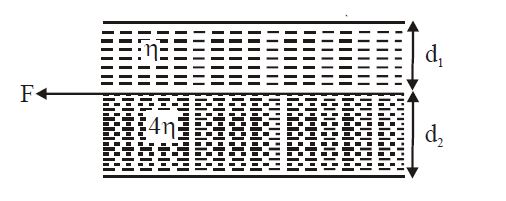
A thin plate separates two liquids of coefficients of viscosity $\eta$ and $4\ \eta$ kept between two fixed plates as shown. If plate has to be pulled by applying minimum force then $\frac{d_2}{d_1}$ is
An electron, a doubly ionized helium ion $\left( He ^{++}\right)$ and a proton are having the same kinetic energy. The relation between their respective de$-$Broglie wavelengths $\lambda_{ e }, \lambda_{ He ^{++}}$ and $\lambda_{ P }$ is
In Millikan's oil drop experiment an oil drop carrying a charge $Q$ is held stationary by a potential difference $2400\,V$ between the plates. To keep a drop of half the radius stationary the potential difference had to be made $600\,V$. What is the charge on the second drop
The Bohr model of atoms