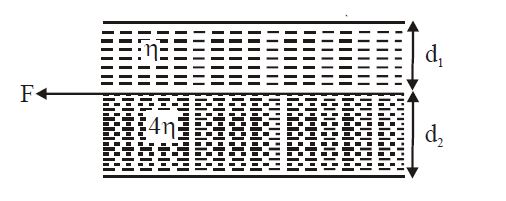
A thin plate separates two liquids of coefficients of viscosity $\eta$ and $4\ \eta$ kept between two fixed plates as shown. If plate has to be pulled by applying minimum force then $\frac{d_2}{d_1}$ is
Advanced


Download our appand get started for free
Experience the future of education. Simply download our apps or reach out to us for more information. Let's shape the future of learning together!No signup needed.*
Similar Questions
- 1Blood velocity: The flow of blood in a large artery of an anesthetised dog is diverted through a Venturi meter. The wider part of the meter has a crosssectional area equal to that of the artery. $A = 8\; mm^2$. The narrower part has an area $a = 4 \;mm^2$. The pressure drop in the artery is $24\; Pa$. What is the speed (in $m/s$) of the blood in the artery?View Solution
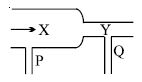
- 2A steady flow of water passes along a horizontal tube from a wide section $X$ to the narrower section $Y$, see figure. Manometers are placed at $P$ and $Q$ at the sections. Which of the statements $A, B, C, D, E$ is most correct?View Solution
- 3A cube of wood supporting $200\,gm$ mass just floats in water. When the mass is removed, the cube rises by $2\, cm$. ............ $cm$ is the side of cube .View Solution
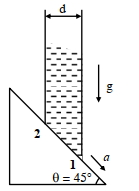
- 4A cylindrical tube, with its base as shown in the figure, is filled with water. It is moving down with a constant acceleration $a$ along a fixed inclined plane with angle $\theta=45^{\circ} . P_1$ and $P_2$ are pressures at points 1 and 2 , respectively, located at the base of the tube. Let $\beta=\left(P_1-P_2\right) /(\rho g d)$, where $\rho$ is density of water, $d$ is the inner diameter of the tube and $g$ is the acceleration due to gravity. Which of the following statement($s$) is(are) correct?View Solution
$(A)$ $\beta=0$ when $a= g / \sqrt{2}$
$(B)$ $\beta>0$ when $a= g / \sqrt{2}$
$(C)$ $\beta=\frac{\sqrt{2}-1}{\sqrt{2}}$ when $a= g / 2$
$(D)$ $\beta=\frac{1}{\sqrt{2}}$ when $a= g / 2$
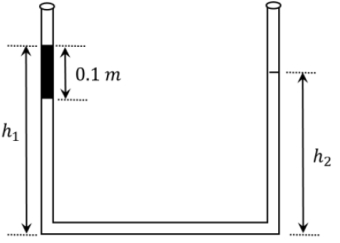
- 5An open-ended U-tube of uniform cross-sectional area contains water (density $10^3 kg m ^{-3}$ ). Initially the water level stands at $0.29 m$ from the bottom in each arm. Kerosene oil (a water-immiscible liquid) of density $800 kg m ^{-3}$ is added to the left arm until its length is $0.1 m$, as shown in the schematic figure below. The ratio $\left(\frac{h_1}{h_2}\right)$ of the heights of the liquid in the two arms is-View Solution
- 6A small spherical ball of radius $r$, falling through a viscous medium of negligible density has terminal velocity ' $v$ '. Another ball of the same mass but of radius $2 r$, falling through the same viscous medium will have terminal velocity:View Solution
- 7A wide vessel with a small hole at the bottom is filled with two liquids. The density and heightof one liquid are $\rho_1$ and $h_1$ and that of the otherare $\rho_2$ and $h_2 \ (\rho_1 >\rho_2)$. The velocity of liquid coming out of the hole is :View Solution
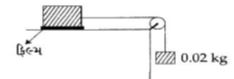
- 8A metal block of base area $0.2\; m ^{2}$ is connected to a $0.02\; kg$ mass via a string that passes over an ideal pulley as shown in figure. A liquid film of thickness $0.6\; mm$ is placed between the block and the table. When released the block moves to the right with a constant speed of $0.17\; m / s$. The co-efficient of viscosity of the liquid isView Solution
- 9A liquid of density $10^3 \,kg / m ^3$ and coefficient of viscosity $8 \times 10^{-2} \;decapoise$ is flowing in a tube of radius $2 \,cm$ with speed $2 \,m / s$. The Reynold's number is ..........View Solution
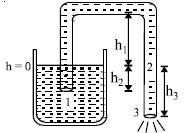
- 10Figure shows a siphon. Choose the wrong statement:View Solution
($P_0$ = atmospheric pressure)