MCQ
The material which practically does not show elastic after effect is
  • A
    Copper
  • B
    Rubber
  • C
    Steel
  • Quartz

Answer

Correct option: D.
Quartz
d
(d) Quartz is the substance which shows practically no$-$elastic after effect.

Need a full question paper?

Generate a complete, print-ready paper with questions like this in minutes — across 16+ boards, with answer keys.

Start Generating Free

Similar questions

The quantity having the same unit in all system of unit is:
The quantity on which the rise of liquid in capillary tube does not depend upon is
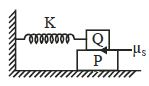
A block $P$ of mass $m$ is placed on a smooth horizontal surface. A block $Q$ of same mass is placed over the block $P$ and the coefficient of static friction between them is ${\mu _S}$. A spring of spring constant $K$ is attached to block $Q$. The blocks are displaced together to a distance $A$ and released. The upper block oscillates without slipping over the lower block. The maximum frictional force between the block is
A body is thrown vertically upwards with a velocity $u$. Find the true statement from the following
A person sitting firmly over a rotating stool has his arms stretched. If he folds his arms, his angular momentum about the axis of rotation:
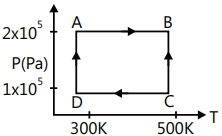
Two moles of helium gas are taken over the cycle $ABCDA$, as shown in the $P-T$ diagram. Assuming the gas to be ideal the work done on the gas in taking it from $A $ to $B$ is ...... $R$
Two Carnot engines $A$ and $B$ are operated in succession. The first one, $A$ receives heat from a source at ${T_1} = 800K$ and rejects to sink at ${T_2}K.$. The second engine $B$ receives heat rejected by the first engine and rejects to another sink at ${T_3} = 300K.$ If the work outputs of two engines are equal, then the value of ${T_2}$ is .... $K$
If $\vec F$ is the force acting on a particle having position vector $\vec r$ and $\vec \tau$ be the torque of this force about the origin, then
Two sound waves with wavelengths $5.0\,\, m$ and $5 .5\,\, m$ respectively, each propagate in a gas with velocity $330\,\, m/s.$ We expect the following number of beats per second. 
The physical quantity $'$Energy Density$'$ has same dimensional formula as