MCQ
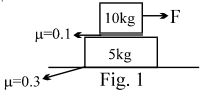
The maximum acceleration of $5\, kg$ block  ...... $m/s^2$
  • A
    $1$
  • B
    $3$
  • $0$
  • D
    None

Answer

Correct option: C.
$0$
c
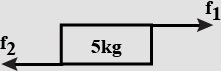
From $FBD$ of $5\, kg$ mass,

Friction force to the right due to $F$ is $f_{1}=0.1 \times 10 \times 10=10 N$

Friction force to the left due to $F$ is $f_{1}=0.1 \times(10+5) \times 10=45 N$

As $10 \mathrm{N}<45 \mathrm{N},$ the $5 \mathrm{kg}$ block will not move.

Therefore its acceleration is $0 m / s^{2}$
Need a full question paper?

Generate a complete, print-ready paper with questions like this in minutes — across 16+ boards, with answer keys.
Start Generating Free

Similar questions

A ball thrown by one player reaches the other in $2\, sec$. The maximum height attained by the ball above the point of projection will be about .......... $m$
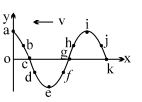
The figure represents the instantaneous picture of a longitudinal harmonic wave travelling along the negative $x$-axis. Identify the correct statement $(s)$ related to the movement of the points shown in the figure. The points moving in the direction of wave are
In a diatomic molecule, the rotational energy at a given temperature.
  1. Obeys Maxwell’s distribution.
  2. Have the same value for all molecules.
  3. Equals the translational kinetic energy for each molecule.
  4. Is (2/3)rd the translational kinetic energy for each molecule.
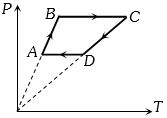
Six moles of an ideal gas perfomrs a cycle shown in figure. If the temperature are $T_A = 600 K, T_B = 800 K, T_C = 2200 K \,and\, T_D = 1200 K$, the work done per cycle is ..... $kJ$
A person sitting firmly over a rotating stool has his arms stretched. If he folds his arms, his angular momentum about the axis of rotation:
The Working of an atomizer depends upon
The number of significant figures in 0.06900 is:
  1. 5.
  2. 4.
  3. 2
  4. 3.
For hydrogen gas ${C_p} - {C_v} = a$ and for oxygen gas ${C_p} - {C_v} = b$. So the relation between $a$ and $b$ is given by
Two bodies begin a free fall from the same height at a time interval of $N s$. If vertical separation between the two bodies is $1$ after $n\, second$ from the start of the first body, then $n$ is equal to
A body of mass $1\, kg$ is under a force, which causes a displacement in it is given by $x = \frac{{{t^3}}}{3}$ (in $m$). Find the work done by the force in first second ............ $\mathrm{J}$