MCQ
The maximum efficiency of full wave rectifier is.........$\%$
  • A
    $100$
  • B
    $25.20$
  • C
    $40.2$
  • $81.2$

Answer

Correct option: D.
$81.2$
d
(d)For full wave rectifier $\eta = \frac{{81.2}}{{1 + \frac{{{r_f}}}{{{R_L}}}}}$
==> ${n_{\max }} = 81.2\% $ $(rf << RL)$

Need a full question paper?

Generate a complete, print-ready paper with questions like this in minutes — across 16+ boards, with answer keys.
Start Generating Free

Similar questions

$OCH - CHO\xrightarrow{{O{H^ - }}}HO{H_2}C - COOH$  The reaction given is
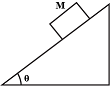
A mass $M$ is placed on a very smooth wedge resting on a surface without friction. Once the mass is released, the acceleration to be given to the wedge so that $M$ remains at rest is $a$ where
A tennis ball is dropped on to the floor from a height of $9.8\,m$. It rebounds to a height $5.0\,m$. Ball comes in contact with the floor for $0.2\,s$. The average acceleration during contact is $..........ms ^{-2}$. [Given $g =10\,ms ^{-2}$ ]
The force required just to move a body up an inclined plane is double the force required just to prevent the body sliding down. If the coefficient of friction is $0.25$, the angle of inclination of the plane is ...... $^o$
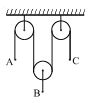
The pulleys in the diagram are all smooth and light. The acceleration of $A$ is a upwards and the acceleration of $C$ is $f$ downwards. The acceleration of $B$ is
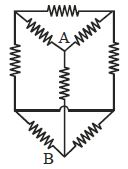
Effective resistance between points $A$ and $B$ for following network is  (each branch of resistance is $R$)
A steel wire has a resistance twice that of an aluminium wire. Both of them are connected with a constant voltage supply. More heat will be dissipated in
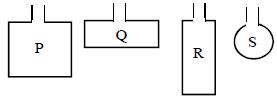
Four wires, each of length $2.0\,m$, are bent into four loops $P,\,Q,\,R$ and $S$ and then suspended in a uniform magnetic field. If the same current is passed in each, then the torque will be maximum on the loop
An ammeter whose resistance is $180\,\Omega $ gives full scale deflection when current is $2\, mA$. The shunt required to convert it into an ammeter reading $20\, mA$ (in $ohms$) is
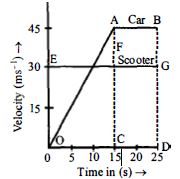
The velocity-time graphs of a car and a scooter are shown in the figure. $(i)$ the difference between the distance travelled by the car and the scooter in $15\, s$ and $(ii)$ the time at which the car will catch up with the scooter are, respectively