MCQ
The maximum horizontal range of a projectile is $16\,km$ when the projectile is thrown at an elevation of $30^o$ from the horizontal, it will reach to the maximum height of ....... $km$
  • $2$
  • B
    $4$
  • C
    $8$
  • D
    $16$

Answer

Correct option: A.
$2$
a
$\mathrm{R}=\frac{\mathrm{u}^{2} \sin 2 \theta}{\mathrm{g}}$ so that $\mathrm{R}_{\max }=\frac{\mathrm{u}^{2}}{\mathrm{g}}=16 \mathrm{km}$

$\mathrm{H}_{\max }=\frac{\mathrm{u}^{2} \sin ^{2} \theta}{2 \mathrm{g}}=2 \mathrm{km}$

Need a full question paper?

Generate a complete, print-ready paper with questions like this in minutes — across 16+ boards, with answer keys.

Start Generating Free

Similar questions

The dimensions of $\left(\frac{ B ^{2}}{\mu_{0}}\right)$ will be.

(if $\mu_{0}$ : permeability of free space and $B$ : magnetic field)

Let Cv and Cp denote the molar heat capacities of an ideal gas at constant volume and constant pressure respectively. Which of the following is a universal constant?

  1. $\frac{\text{C}_\text{P}}{\text{C}_\text{V}}$

  2. $\text{C}_\text{P}\text{C}_\text{V}$

  3. $\text{C}_\text{P}-\text{C}_\text{V}$

  4. $\text{C}_\text{P}+\text{C}_\text{V}$

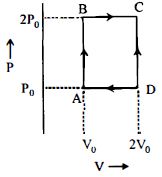
An engine operates by taking $n\,moles$ of an ideal gas through the cycle $ABCDA$ shown in figure. The thermal efficiency of the engine is : (Take $C_v =1 .5\, R$, where $R$ is gas constant)
A cylindrical vessel of height $500 \mathrm{~mm}$ has an orifice (small hole) at its bottom. The orifice is initially closed and water is filled in it up to height $\mathrm{H}$. Now the top is completely sealed with a cap and the orifice at the bottom is opened. Some water comes out from the orifice and the water level in the vessel becomes steady with height of water column being $200 \mathrm{~mm}$. Find the fall in height (in ${m m}$ ) of water level due to opening of the orifice.

|Take atmospheric pressure $=1.0 \times 10^5 \mathrm{~N} / \mathrm{m}^2$, density of water $=1000 \mathrm{~kg} / \mathrm{m}^3$ and $g=10 \mathrm{~m} / \mathrm{s}^2$. Neglect any effect of surface tension.]

particle moves with simple harmonic motion in a straight line. In first $\tau\ s$, after starting from rest it travels a distance $a$, and in next $\tau\ s$ it travels $2a$, in same direction, then
In figure, two blocks $M$ and $m$ are tied together with an inextensible and light string. The mass $M$ is placed on a rough horizontal surface with coefficient of friction $\mu$ and the mass $m$ is hanging vertically against a smooth vertical wall. The pulley is frictionless. Choose the correct statement $(s)$
A train is moving towards north. At one place it turns towards north-east, here we observe that
Sand is being dropped on a conveyer belt at the rate of $2\,kg$ per second . The force necessary to keep the belt moving with a constant speed of $3\,ms^{-1}$ will be  ........... $N$
Mark the correct statements:
  1. The magnitude of the velocity of a particle is equal to its speed.
  2. The magnitude of average velocity in an interval is equal to its average speed in that interval
  3. It is possible to have a situation in which the speed of a particle is always zero but the average speed is not zero.
  4. It is possible to have a situation in which the speed of the particle is never zero but the average speed in an interval is zero.
Let $[ {\varepsilon _0} ]$ denote the dimensional formula of the permittivity of vacuum. If $M =$ mass, $L=$ length, $T =$ time and $A=$ electric current, then: