MCQ
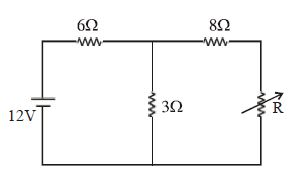
The maximum power delivered to resistance $R$ is  ............... $W$
  • A
    $0.2$
  • $0.4$
  • C
    $0.8$
  • D
    $0.16$

Answer

Correct option: B.
$0.4$
b
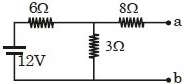
$P_{\max }=\frac{V_{a b}^{2}}{4 R_{a b}} ; P_{\max }=\frac{16}{4 \times 10}=0.4 \mathrm{\,watt}$

$\mathrm{V}_{\mathrm{ab}}=\frac{12}{9} \times 3=4 \mathrm{\,volt}$

$\mathrm{R}_{\mathrm{ab}}=8+\frac{6 \times 3}{9}=8+2=10\, \Omega$
Need a full question paper?

Generate a complete, print-ready paper with questions like this in minutes — across 16+ boards, with answer keys.
Start Generating Free

Similar questions

The bottom of a container filled with liquid appear slightly raised because of
An electric motor operating on a 60 V dc supply draws a current of 10 A. If the efficiency of the motor is 50%, the resistance of its winding is
A beam of well collimated cathode rays travelling with a speed of $5 \times {10^6}\,m{s^{ - 1}}$ enter a region of mutually perpendicular electric and magnetic fields and emerge undeviated from this region. If $| B |=0.02\; T$, the magnitude of the electric field is
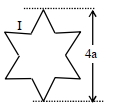
A symmetric star conducting wire loop is carrying a steady state current $\mathrm{I}$ as shown in figure. The distance between the diametrically opposite vertices of the star is $4 a$. The magnitude of the magnetic field at the center of the loop is
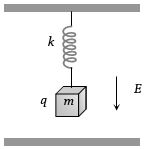
Time period of a block suspended from the upper plate of a parallel plate capacitor by a spring of stiffness $k$ is $T$. When block is uncharged. If a charge $q$ is given to the block them, the new time period of oscillation will be
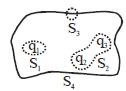
Three charges $q_1 = 1\,\mu c, q_2 = 2\,\mu c$ and $q_3 = -3\,\mu c$ and four surfaces $S_1, S_2 ,S_3$ and $S_4$ are shown in figure. The flux emerging through surface $S_2$ in $N-m^2/C$ is
A galvanometer has resistance of $7\,\Omega $ and gives a full scale deflection for a current of $1.0\, A$. How will you convert it into a voltmeter of range $10\, V$
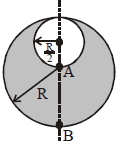
Consider a sphere of radius $\mathrm{R}$ which carries a uniform charge density $\rho .$ If a sphere of radius $\frac{\mathrm{R}}{2}$ is carved out of it, as shown, the ratio $\frac{\left|\overrightarrow{\mathrm{E}}_{\mathrm{A}}\right|}{\left|\overrightarrow{\mathrm{E}}_{\mathrm{B}}\right|}$ of magnitude of electric field $\overrightarrow{\mathrm{E}}_{\mathrm{A}}$ and $\overrightarrow{\mathrm{E}}_{\mathrm{B}}$ respectively, at points $\mathrm{A}$ and $\mathrm{B}$ due to the remaining portion is
If the atom $_{100}F{m^{257}}$ follows the Bohr model and the radius of $_{100}F{m^{257}}$ is $n$ times the Bohr radius, then find $n$
Electrons with energy 80 keV are incident on the tungsten target of an X-ray tube. K shell electrons of tungsten have ionization energy 72.5 keV. X-rays emitted by the tube contain only