Question
The maximum speed and acceleration of a particle executing simple harmonic motion are $10cm/s$ and $50cm/s^2$. Find the position(s) of the particle when the speed is 8cm/s.

Answer

$\text{v}_{\text{max}}=10\text{cm/sec}.$$\Rightarrow\text{r}\omega=10$
$\Rightarrow\omega^2=\frac{100}{\text{r}^2}\ ...(1)$
$\text{A}_{\text{max}}=\omega^2\text{r}=50\text{cm/sec}$
$\Rightarrow\omega^2=\frac{50}{\text{y}}=\frac{50}{\text{r}}\ ...(2)$
$\therefore\frac{100}{\text{r}^2}=\frac{50}{\text{r}}$
$\Rightarrow\text{r}=2\text{cm}.$
$\therefore\omega=\sqrt{\frac{100}{\text{r}^2}}=5\sec^2$
Again, to find out the positions where the speed is 8m/sec,
$\text{v}^2=\omega^2(\text{r}^2-\text{y}^2)$
$\Rightarrow64=25(4-\text{y}^2)$
$\Rightarrow4-\text{y}^2=\frac{64}{25}$
$\Rightarrow\text{y}^2=1.44$
$\Rightarrow\text{y}=\sqrt{1.44}$
$\Rightarrow\text{y}=\pm1.2\text{cm}$ from mean position.

Need a full question paper?

Generate a complete, print-ready paper with questions like this in minutes — across 16+ boards, with answer keys.

Start Generating Free

Similar questions

Calculate the fall in temperature when a gas initially at $72°C$ is expanded suddenly to eight times its original volume. Given y $=\frac53.(\therefore\text{V}_2=8\text{x}\text{ c.c.})$
A student records the initial length l, change in temperature $\Delta\text{T}$ and change in length $\Delta\text{l}$ of a rod as follows:
S.NO.
l(m)
$\Delta\text{T(C)}$
$\Delta\text{l}(\text{m})$
1.
2
10
$4 \times 10^{-4}$
2.
1
10
$4 \times 10^{-4}$
3.
2
20
$2 \times 10^{-4}$
4.
3
10
$6 \times 10^{-4}$
If the first observation is correct, what can you say about observations 2, 3 and 4.
A man of mass $70kg$ stands on a weighing scale in a lift which is moving. Downwards with a uniform acceleration of $5ms^{-2}$.
A particle is subjected to two simple harmonic motions, one along the X-axis and the other on a line making an angle of 45° with the X-axis, The two motions are given by,$\text{x}=\text{x}_0\sin\omega\text{t}$ and $\text{s}=\text{s}_0\sin\omega\text{t}$
Find the amplitude of the resultant motion.
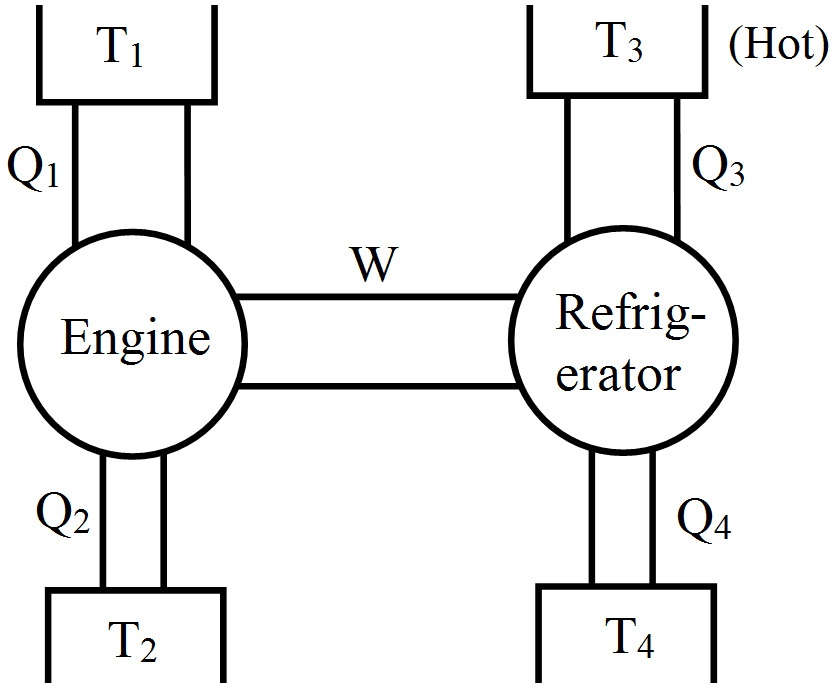
An ideal engine works between temperatures $T_1$ and $T_2$. It derives an ideal refrigerator that works between temperatures $T_3$ and $T_4$. Find the ratio $\frac{\text{Q}_3}{\text{Q}_1}$ in terms of $T_1, T_2, T_3$ and $T_4$.
A wheel rotating with uniform angular acceleration covers 50 revolutions in the first five seconds after the start. Find the angular acceleration and the angular velocity at the end of five seconds.
A steel wire of mass 4.0g and length 80cm is fixed at the two ends. The tension in the wire is 50N. Find the frequency and wavelength of the fourth harmonic of the fundamental.
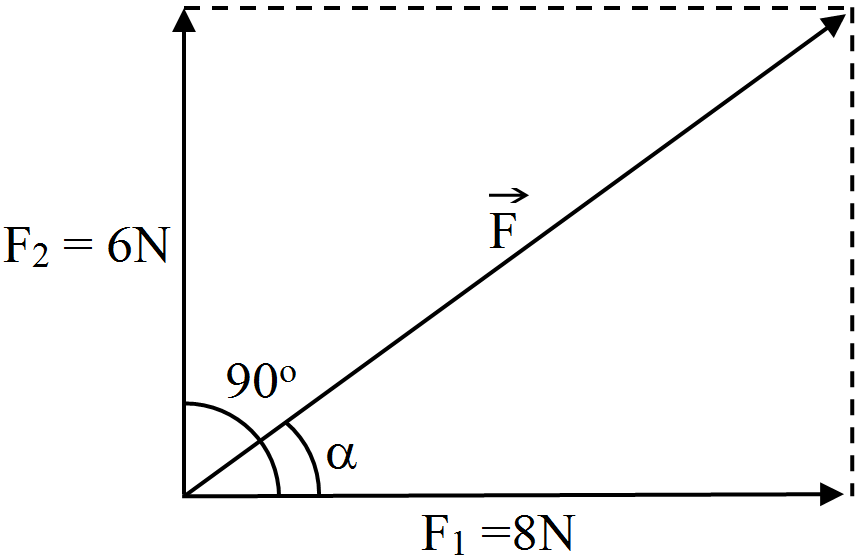
Two mutually perpendicular forces of $8N$ and $6N$ acts on the same body of mass $10\ kg$. Calculate
  1. Net force acting on the body,
  2. Magnitude of the acceleration of the body,
  3. Direction of acceleration of the body.
The decay constant of ${ }^{238} \mathrm{U}$ is $4.9 \times 10^{-18} \mathrm{~S}^{-1}$.
a. What is the average$-$life of ${ }^{238} \mathrm{U}$ ?
b. What is the half$-$life of ${ }^{238} \mathrm{U}$ ?
c. By what factor does the activity of a ${ }^{238} \mathrm{U}$ sample decrease in $9 \times 10^9$ years?
Viscous force increase the velocity of a satellite. Discuss.