Question
A wheel rotating with uniform angular acceleration covers 50 revolutions in the first five seconds after the start. Find the angular acceleration and the angular velocity at the end of five seconds.

Answer

$\theta=100\pi;\ \text{t}=5\text{sec}$ $\theta=\frac{1}{2}\alpha\text{t}^2$ $\Rightarrow100\pi=\frac{1}2{}\alpha25$ $\Rightarrow\alpha=8\pi\times5=40\pi\text{rad/s}=20\text{rev/s}$ $\therefore\alpha=8\pi\text{rad/s}^2=4\text{rev/s}^2$ $\omega=40\pi\text{rad/s}^2=20\text{rev/s}^2$

Need a full question paper?

Generate a complete, print-ready paper with questions like this in minutes — across 16+ boards, with answer keys.
Start Generating Free

Similar questions

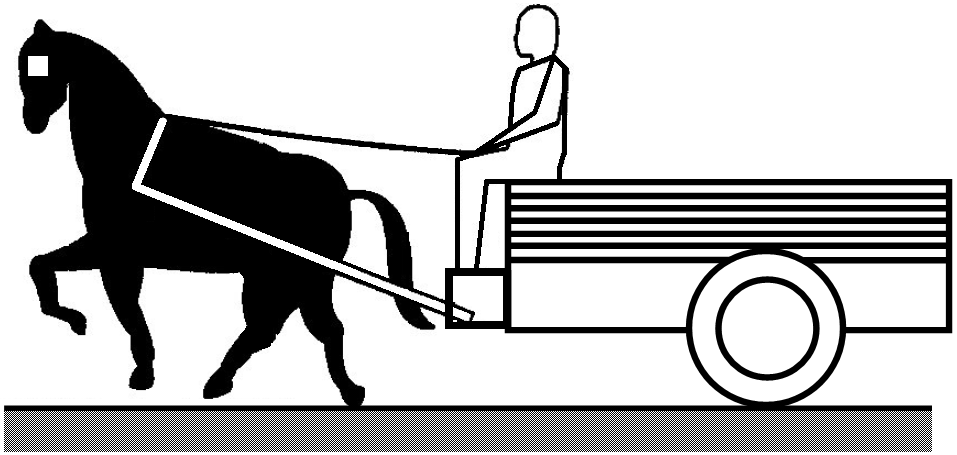
Figure shows a cart. Complete the table shown.
A particle is released from the top of an incline of height h. Does the kinetic energy of the particle at the bottom of the incline depend on the angle of incline? Do you need any more information to answer this question in Yes or No?
When the planet Jupiter is at a distance of 824.7 million kilometers from the Earth, its angular diameter is measured to be 35.72” of arc. Calculate the diameter of Jupiter.
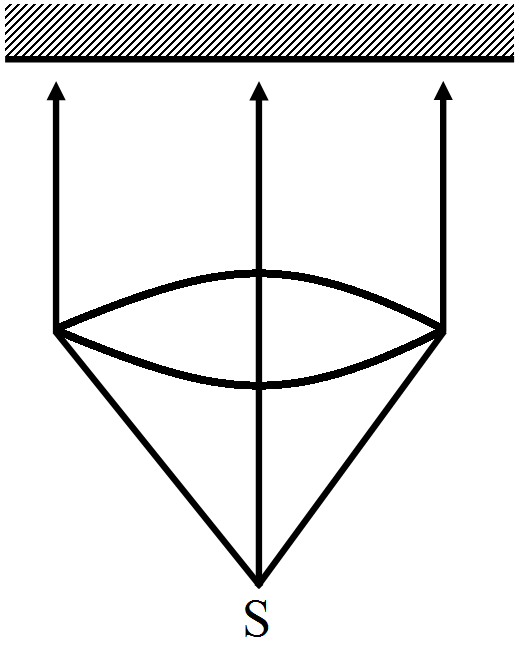
A totally reflecting, small plane mirror placed horizontally faces a parallel beam of light, as shown in the figure. The mass of the mirror is $20g$. Assume that there is no absorption in the lens and that $30\%$ of the light emitted by the source goes through the lens. Find the power of the source needed to support the weight of the mirror. Take $g = 10m/s^2$.
A student records the initial length l, change in temperature $\Delta\text{T}$ and change in length $\Delta\text{l}$ of a rod as follows:
S.NO.
l(m)
$\Delta\text{T(C)}$
$\Delta\text{l}(\text{m})$
$1.$
$2
$10
$4 \times 10^{-4}$
$2.
$1
$10
$4 \times 10^{-4}$
$3.
$2
$20
$2 \times 10^{-4}$
$4.
$3
$10
$6 \times 10^{-4}$
If the first observation is correct, what can you say about observations 2, 3 and 4.
A 100W light bulb is placed at the centre of a spherical chamber of radius 20cm. Assume that 60% of the energy supplied to the bulb is converted into light and that the surface of the chamber is perfectly absorbing. Find the pressure exerted by the light on the surface of the chamber.
A particle of mass $0.1kg$ is held between two rigid supports by two springs of force constants $8N/ m$ and $2N/ m$. If the particle is displaced along the direction of the length of the springs, calculate its frequency of vibration.
If the separation between the slits in a Young's double slit experiment is increased, what happens to the fringe-width? If the separation is increased too much, will the fringe pattern remain detectable?
What is the pressure inside the drop of mercury of radius $3.00mm$ at room temperature? Surface tension of mercury at that temperature $(20^\circ C) is 4.65 \times 10^{–1}N m^{–1}$. The atmospheric pressure is $1.01 × 10⁵Pa$. Also give the excess pressure inside the drop.