MCQ
The maximum static frictional force is
  • A
    Equal to twice the area of surface in contact
  • Independent of the area of surface in contact
  • C
    Equal to the area of surface in contact
  • D
    None of the above

Answer

Correct option: B.
Independent of the area of surface in contact
b
The maximum static frictional force is independent of the area of surface in contact We know that: $f=y N=\mu i n g$. $f \propto \mu, f \propto m ;$

Need a full question paper?

Generate a complete, print-ready paper with questions like this in minutes — across 16+ boards, with answer keys.
Start Generating Free

Similar questions

The principle of conservation of linear momentum can be strictly applied during a collision between two particles provided the time of impact is
Which of the following statements is true
At a certain temperature, the $r.m.s.$ velocity for ${O_2}$ is $400\, m/sec.$ At the same temperature, the $r.m.s.$ velocity for ${H_2}$ molecules will be ....... $m/sec$
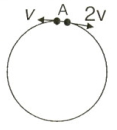
Two small particles of equal masses start moving in opposite directions from a point $A$ in a horizontal circular orbit. Their tangential velocities are $v$ and $2 v$, respectively, as shown in the figure. Between collisions, the particles move with constant speeds. After making how many elastic collisions, other than that at $A$, these two particles will again reach the point $A$ ?
The initial position of an object at rest is given by $3 \hat{i}-8 \hat{j}$ It moves with constant acceleration and reaches to the position $2 \hat{i}+4 \hat{j}$ after $4 \,s$. What is its acceleration?
When an object is accelerated:
Static friction occurs.
A metro train starts from rest and in five seconds achieves $108\, km/h$. After that it moves with constant velocity and comes to rest after travelling $45\, m$ with uniform retardation. If total distance travelled is $395\,m$, then total time of travelling is.......$sec$
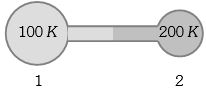
Figure shows two flasks connected to each other. The volume of the flask $1$ is twice that of flask $2.$ The system is filled with an ideal gas at temperature $100\, K$ and $200 \,K $ respectively. If the mass of the gas in $1$ be $m$ then what is the mass of the gas in flask $2$
A container of volume $1{m^3}$is divided into two equal compartments by a partition. One of these compartments contains an ideal gas at $300 K$. The other compartment is vacuum. The whole system is thermally isolated from its surroundings. The partition is removed and the gas expands to occupy the whole volume of the container. Its temperature now would be ..... $K$