MCQ
When an object is accelerated:
  • A
    Its direction must be constant
  • Its velocity is necessarily changing
  • C
    Its velocity is constant
  • D
    Its speed is necessarily changing

Answer

Correct option: B.
Its velocity is necessarily changing
$b.$ Its velocity is necessarily changing
Explanation:
Acceleration is the time rate of change of velocity.

Need a full question paper?

Generate a complete, print-ready paper with questions like this in minutes — across 16+ boards, with answer keys.
Start Generating Free

Similar questions

Path length does not depend on $...........$
A loaded spring gun of mass $M$ fires a 'shot' of mass $m$ with a velocity at an angle of elevation $\theta.$ The gun is initially at rest on a horizontal frictionless surface. After firing, the centre of mass of the gun$-$shot system.
A capacitor $C _1$ of capacitance $1 \mu F$ and a capacitor $C _2$ of capacitance $2 \mu F$ are separately charged by a common battery for a long time. The two capacitors are then separately discharged through equal resistors. Both the discharge circuits are connected at $t =0$.
Maximum speed of sound is:
Particles of masses $m, 2m, 3m,......nm$ $grams$ are placed on the same line at distances $l, 2l, 3l,....nl\, cm$ from a fixed point. The distance of centre of mass of the particles from the fixed point in centimetres is
Two photons having:
Which of the following units denotes the dimensions $\frac{{M{L^2}}}{{{Q^2}}}$, where $Q$
denotes the electric charge?
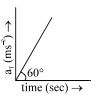
Tangential acceleration of a particle moving in a circle of radius $1$ $m$ varies with time $t$ as (initial velocity of particle is zero). Time after which total acceleration of particle makes and angle of $30^o$ with radial acceleration is
In an orbit if the time of revolution of a satellite is $T$, then $P E$ is proportional to
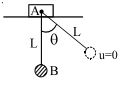
$A$ small ball $B$ of mass $m$ is suspended with light inelastic string of length $L$ from $a$ block $A$ of same mass $m$ which can move on smooth horizontal surface as shown in the figure. The ball is displaced by angle $\theta$ from equilibrium position & then released. Maximum velocity of block during subsequent motion of the system after release of ball is