MCQ
The maximum value of $\Big(\frac{1}{\text{x}}\Big)^\text{x}$ is :
  • A
    $\text{e}$
  • B
    $\text{e}^\text{e}$
  • $\frac{1}{_\text{e}\text{e}}$
  • D
    $\Big(\frac{1}{\text{e}}\Big)^{\frac{1}{\text{e}}}$
Answer

Correct option: C.
$\frac{1}{_\text{e}\text{e}}$
Let $\text{y}=\Big(\frac{1}{\text{x}}\Big)^\text{x}$
$\Rightarrow\ \log\text{y}=\text{x}\cdot\log\frac{1}{\text{x}}=-\text{x}\cdot\log\text{x}$
Diffrentiating both sides $\text{w.r.t x,}$ we get,
$\frac{1}{\text{y}}\cdot\frac{\text{dy}}{\text{dx}}=-\text{x}\cdot\frac{1}{\text{x}}-\log\text{x}$
$=-1-\log\text{x}$
$\therefore\ \frac{\text{dy}}{\text{dx}}=-\Big(\frac{1}{\text{x}}\Big)^\text{x}(1+\log\text{x})$
Now, $\frac{\text{dy}}{\text{dx}}=0$
$\Rightarrow\ 1+\log\text{x}=0$
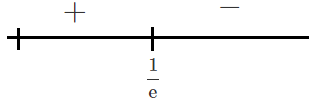
$\Rightarrow\ \text{x}=\frac{1}{\text{e}}$
Sign scheme of $f\ '(x)$ is as shown in the following figure.

From the figure, $\text{x}=\frac{1}{\text{e}}$ is the point of maxima
Hence, maximum value of $y$ is $\Big(\frac{1}{\frac{1}{\text{e}}}\Big)^{\frac{1}{\text{e}}}=\text{e}^{\frac{1}{\text{e}}}$

Need a full question paper?

Generate a complete, print-ready paper with questions like this in minutes — across 16+ boards, with answer keys.

Start Generating Free

Similar questions

If $\text{x}=\text{f}(\text{t})\cos\text{t}-\text{f}(\text{t})\sin\text{t}\ \text{and}\ \text{y}=\text{f}(\text{t})\sin\text{t}+\text{f}(\text{t})\cos\text{t},$ then $\Big(\frac{\text{dx}}{\text{dt}}\Big)^2+\Big(\frac{\text{dy}}{\text{dt}}\Big)^2=$
Let A = {1, 2, 3}. Then, the number of relations containing (1, 2) and (1, 3) which are reflexive and symmetric but not transitive is:
If $tan^{-1} (x^2 + 3|x|-4 )= tan^{-1} (4 \pi + sin^{-1}(sin14))$, then the value of $cos^{-1}(cos3|x|)$ is equal to
An anti-aircraft gun take a maximum of four shots at an enemy plane moving away from it. The probability of hitting the plane at the first, second, third and fourth shot are $0.4, 0.3, 0.2$ and $0.1$ respectively. The probability that the gun hits the plane is
The value of $\sin^{-1}\Big(\cos\frac{33\pi}{5}\Big)$ is:
The existence of the unique solution of the system of equations:
$x + y + z = \lambda$
$5x − y + µz = 10$
$2x + 3y − z = 6$
depends on
If ${\tan ^{ - 1}}(x - 1) + {\tan ^{ - 1}}x + {\tan ^{ - 1}}(x + 1) = {\tan ^{ - 1}}3x$, then  $  x =$
Let $a$ be an integer such that all the real roots of the polynomial $2 x^{5}+5 x^{4}+10 x^{3}+10 x^{2}+10 x+10$ lie in the interval $(a, a+1) .$ Then, $| a |$ is equal to ...... .
For a real number $x$ let $[x]$ denote the largest integer less than or equal to $x$. The smallest positive integer $n$ for which the integral $\int \limits_1^n[x][\sqrt{x}] d x$ exceeds $60$ is
If $\int\limits_0^{f(x)} {{t^2}\,dt} $ $= x\, \cos\, \pi\, x $, then $f ‘ (9)$