The mean free path of electrons in a metal is $4 \times 10^{-8} \;m$. The electric field which can give on an average $2 \;eV$ energy to an electron in the metal will be in units of $V / m$
AIPMT 2009, Medium


Download our appand get started for free
Experience the future of education. Simply download our apps or reach out to us for more information. Let's shape the future of learning together!No signup needed.*
Similar Questions
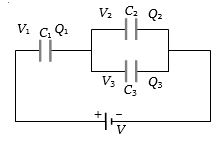
- 1In an adjoining figure are shown three capacitors ${C_1}$,${C_2}$ and ${C_3}$ joined to a battery. The correct condition will be (Symbols have their usual meanings)View Solution
- 2View SolutionWhen we touch the terminals of a high voltage capacitor, even after a high voltage has been cut off, then the capacitor has a tendency to
- 3This question contains Statement$-1$ and Statement$-2$. Of the four choices given after the statements, choose the one that best describes the two statements.View Solution
Statement$-1$ : For a charged particle moving from point $P$ to point $Q$, the net work done by an electrostatic field on the particle is independent of the path connecting point $P$ to point $Q$.
Statement$-2$ : The net work done by a conservative force on an object moving along a closed loop is zero. - 4View SolutionEqual charges are given to two spheres of different radii. The potential will
- 5A capacitor of capacity $C$ is connected with a battery of potential $V$ in parallel. The distance between its plates is reduced to half at once, assuming that the charge remains the same. Then to charge the capacitance upto the potential $V$ again, the energy given by the battery will beView Solution
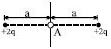
- 6A negative point charge placed at the point $A$ isView Solution
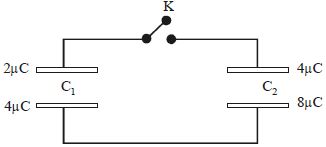
- 7Assertion : Charges are given to plates of two plane parallel plate capacitors $C_1$ and $C_2$ (such that $C_2 = 2C_1$ ) as shown in figure. Then the key $K$ is pressed to complete the circuit. Finally the net charge on upper plate and net charge the circuit. Finally the net charge on upper plate and net charge on lower plate of capacitor $C_1$ is positive.View Solution
Reason : In a parallel plate capacitor both plates always carry equal and opposite charge.
- 8A force of $10 \; N$ acts on a charged particle placed between two plates of a charged capacitor. If one plate of capacitor is removed, then the force acting on that particle will be ...... $N$View Solution
- 9A $10\,\mu F$ capacitor and a $20\,\mu F$ capacitor are connected in series across a $200\;V$ supply line. The charged capacitors are then disconnected from the line and reconnected with their positive plates together and negative plates together and no external voltage is applied. What is the potential difference across each capacitorView Solution
- 10If the electric potential at any point $(x, y, z) \,m$ in space is given by $V =3 x ^{2}$ volt. The electric field at the point $(1,0,3) \,m$ will be ............View Solution