MCQ
The mean free path of the molecules of a gas is proportional to:
  • A
    pressure
  • temperature
  • C
    volume
  • D
    density

Answer

Correct option: B.
temperature
B

Need a full question paper?

Generate a complete, print-ready paper with questions like this in minutes — across 16+ boards, with answer keys.

Start Generating Free

Similar questions

Newton's third law of motion gives.
A particle of mass $m$ is attached to one end of a mass-less spring of force constant $k$, lying on a frictionless horizontal plane. The other end of the spring is fixed. The particle starts moving horizontally from its equilibrium position at time $t=0$ with an initial velocity $u_0$. When the speed of the particle is $0.5 u_0$, it collies elastically with a rigid wall. After this collision :

$(A)$ the speed of the particle when it returns to its equilibrium position is $u_0$.

$(B)$ the time at which the particle passes through the equilibrium position for the first time is $t=\pi \sqrt{\frac{ m }{ k }}$.

$(C)$ the time at which the maximum compression of the spring occurs is $t =\frac{4 \pi}{3} \sqrt{\frac{ m }{ k }}$.

$(D)$ the time at which the particle passes througout the equilibrium position for the second time is $t=\frac{5 \pi}{3} \sqrt{\frac{ m }{ k }}$.
The mass and volume of a body are $4.237g$ and $2.5\ cm^3$, respectively. The density of the material of the body in correct significant figures is:
On a linear temperature scale $Y$, water freezes at $- 160^o\, Y$ and boils at $- 50^o\, Y$. On this $Y$ scale , a temperature of $340\, K$ would be read as........ $^oY$  ( water freezes at $273\, K$ and boils at $373\, K$)
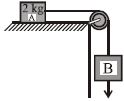
The coefficient of static friction, $\mu _s$ between block $A$ of mass $2\,kg$ and the table as shown in the figure is $0.2$. What would be the maximum mass value of block $B$ so that the two blocks $B$ so that the two blocks do not move? The string and the pulley are assumed to be smooth and masseless ....... $kg$ $(g = 10\,m/s^2)$
When a block of mass $M$ is suspended by a long wire of length $L$, the length of the wire become $(L+l) .$ The elastic potential energy stoped in the extended wire is :
A particle is projected from ground with velocity $u$ at angle $\theta$ from horizontal. Match the following two columns.
Column $I$ Column $II$
$(A)$ Average velocity between initial and final points $(p)$ $u \sin \theta$
$(B)$ Change in velocity between initial and final points $(q)$ $u \cos \theta$
$(C)$ Change in velocity between initial and final points $(r)$ Zero
$(D)$ Average velocity between initial and highest points $(s)$ None of the above
An ideal gas in a cylinder is separated by a piston in such a way that the entropy of one part is $S_{1}$ and that of the other part is $S_{2}$. Given that $S _{1}> S _{2}$. If the piston is removed then the total entropy of the system will be :
The upper end of a wire of radius $4\, mm$ and length $100\, cm$ is clamped and its other end is twisted through an angle of $60^o$. Then angle of shear is .......... $^o$
The pressure at the bottom of a tank containing a liquid does not depend on