MCQ
Newton's third law of motion gives.
  • A
    Definition of force
  • Property of force
  • C
    Definition of inertia
  • D
    Property of inertia

Answer

Correct option: B.
Property of force
B

Need a full question paper?

Generate a complete, print-ready paper with questions like this in minutes — across 16+ boards, with answer keys.
Start Generating Free

Similar questions

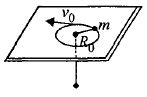
A mass $m$ moves in a circle on a smooth  horizontal plane with velocity $v_0$ at a radius $R_0$ . The mass is attached to a string which passes through a smooth hole in the plane as  shown.The tension in the string is increased gradually and finally $m$ moves in a circle of radius  $\frac{{{R_0}}}{2}$. The final value of the kinetic energy is
A rocket is launched with velocity $10\, km/s$. If radius of earth is $R$, then maximum height attained by it will be
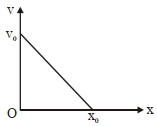
The velocity-displacement graph of a particle is shown in the figure.

The acceleration-displacement graph of the same particle is represented by :
A gaseous mixture contains equal number of hydrogen and nitrogen molecules. Specific heat measurements on this mixture at temperatures below $100\, K$ would indicate that the value of $\gamma $ (ratio of specific heats) for this mixture is
Two vibrating tuning forks produce progressive waves given by $Y_1 = 4\, sin\, 500\pi t$ and $Y_2 = 2\, sin\, 506\, \pi t$ Number of beats produced per minute is 
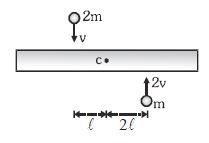
A uniform bar of length $'6l'$ and mass $'8m'$ lies on a smooth horizontal table. Two point masses $m$ and $2m$ moving in the same horizontal plane with speed $2v$ and $v$ respectively, strike the bar (as shown in the fig.) and stick to the bar after collision. Total energy after collision (about the center of mass, $c$) will be :-
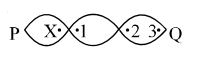
Figure, shows a stationary wave between two fixed points $P$ and $Q$. Which point$(s)$ of $1, 2$ and $3$ are in phase with the point $X?$
Four particles, each of mass $M$ and equidistant from each other, move along a circle of radius $R$ under the action of their mutual gravitational attraction. The speed of each particle is
A long horizontal rod has a bead which can slide along its length, and initially placed at a distance $L$ from one end $A$ of the rod. The rod is set in angular motion about $A$ with constant angular acceleration $\alpha$. If the coefficient of friction between the rod and the bead is $\mu$, and gravity is neglected, then the time after which the bead starts slipping is
The quantity of radiation emitted by a surface per second depends upon :