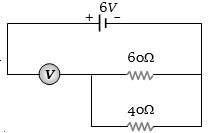
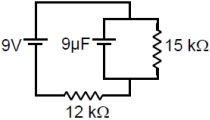
The measurement of voltmeter in the following circuit is ................ $V$
Easy


Download our appand get started for free
Experience the future of education. Simply download our apps or reach out to us for more information. Let's shape the future of learning together!No signup needed.*
Similar Questions
- 1A metal wire of specific resistance $64 \times {10^{ - 6}}\,ohm - cm$ and length $198\, cm$ has a resistance of $7\, ohm$, the radius of the wire will be ............. $cm$View Solution
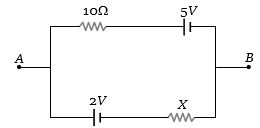
- 2If ${V_{AB}} = 4\,V$ in the given figure, then resistance $X$ will be .............. $\Omega$View Solution
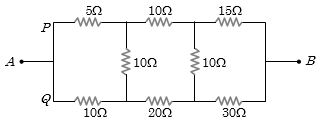
- 3In the arrangement of resistances shown below, the effective resistance between points $A$ and $B$ is ............... $\Omega$View Solution
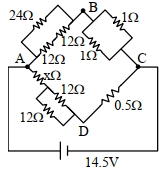
- 4The value of unknown resistance $(x)$ for which the potential difference between $B$ and $D$ will be zero in the arrangement shown, is:View Solution
- 5In a meter bridge experiment null point is obtained at $20\, cm$ from one end of the wire when resistance $X$ is balanced against another resistance $Y$. If $X < Y$, then where will be the new position of the null point from the same end, if one decides to balance a resistance of $4X$ against $Y$ ........... $cm$View Solution
- 6Calculate charge on capacitor in steady state. (in $\mu C$)View Solution
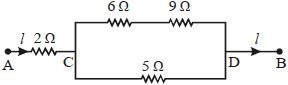
- 7In the circuit shown in figure, the $5\,\Omega $ resistance develops $20.00\,cal/s$ due to the current flowing through it. The heat developed in $2\,\Omega $ resistance (in $cal/s$ ) isView Solution
- 8This question contains statement$-1$ and statement$-2$. Of the four choices given after the statements, choose the one that best describes the two statements.View Solution
statement$-1$ : The temperature dependence of resistance is usually given as $R=R_{0}(1+\alpha \Delta t)$. The resistance of a wire changes from $100\; \Omega$ to $150\; \Omega$ when its temperature is increased from $27^{\circ} C$ to $227^{\circ} C$. This implies that $\alpha=2.5$ $\times 10^{-3} /{ }^{\circ} C$
statement$-2\;: R=R_{0}(1+\alpha \Delta t)$ is valid only when the change in the temperature $\Delta T$ is small and $\Delta R=\left(R-R_{0}\right) < < R_{0}$
- 9The electric bulbs have tungsten filaments of same length. If one of them gives $60 \,watt$ and other $100\, watt$, thenView Solution
- 10The number of dry cells, each of $e.m.f.$ $1.5\,volt$ and internal resistance $0.5\, ohm$ that must be joined in series with a resistance of $20\, ohm$ so as to send a current of $0.6\,A$ through the circuit isView Solution