A metal wire of specific resistance $64 \times {10^{ - 6}}\,ohm - cm$ and length $198\, cm$ has a resistance of $7\, ohm$, the radius of the wire will be ............. $cm$
Easy


Download our appand get started for free
Experience the future of education. Simply download our apps or reach out to us for more information. Let's shape the future of learning together!No signup needed.*
Similar Questions
- 1Four identical cells each having an electromotive force $(e.m.f.)$ of $12\,V$, are connected in parallel. The resultant electromotive force $(e.m.f.)$ of the combination is .............. $V$View Solution
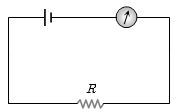
- 2A battery of $e.m.f.$ $10\, V$ and internal resistance $3\,\Omega $ is connected to a resistor as shown in the figure. If the current in the circuit is $0.5\, A$. then the resistance of the resistor will be ............. $\Omega$View Solution
- 3If three resistors of resistance $2 \,\Omega$, $4 \,\Omega$ and $5 \,\Omega$ are connected in parallel then the total resistance of the combination will beView Solution
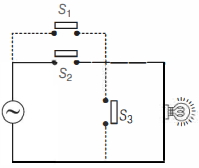
- 4View SolutionConsider the following circuit given below. The bulb will light up, if
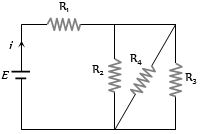
- 5In the circuit given $E = 6.0 \,V, R_1 = 100\, ohms, R_2 = R_3 = 50\, ohms, R_4 = 75\, ohms$. The equivalent resistance of the circuit, in $ohms$, isView Solution
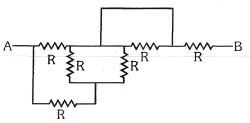
- 6What is the equivalent resistance between $A$ and $B$View Solution
- 7You are given several identical resistances each of value $R = 10\,\Omega $ and each capable of carrying maximum current of $1\, ampere$. It is required to make a suitable combination of these resistances to produce a resistance of $5\,\Omega $ which can carry a current of $4\, amperes$. The minimum number of resistances of the type $R$ that will be required for this jobView Solution
- 8Equivalent resistance between the adjacent corners of a regular $n$-sided polygon of uniform wire of resistance $R$ would be:View Solution
- 9An electric bulb is designed to draw power $P_0$ at voltage $V_0$. If the voltage is $V$ it draws a power $P$. ThenView Solution
- 10Two $220\; V , 100 \;W$ bulbs are connected first in series and then in parallel. Each time the combination is connected to a $220 \;V \;AC$ supply line. The power drawn by the combination in each case respectively will beView Solution