The mechanism of the heat produced in a conductor when an electric current flows through it, can be explained on the basis of
Easy
Download our app for free and get started
Free electron theory:
In metals, most atoms have loosely bound electrons in their outermost orbits, known as free electrons since they have a real nice tendency to detach from their parent atom and move freely. The charge flow occurs due to the movement of electrons. In the presence of an external electric field, all the free electrons would flow in a direction opposite to the field thus constituting a current.
As the electrons move through the metal conductor, some collide with atoms and other electrons or impurities. These collisions cause resistance and generate heat in the conductor.

Download our appand get started for free
Experience the future of education. Simply download our apps or reach out to us for more information. Let's shape the future of learning together!No signup needed.*
Similar Questions
- 1View SolutionAn energy source will supply a constant current into the load if its internal resistance is
- 2View SolutionIf an observer is moving with respect to a stationary electron, then he observes
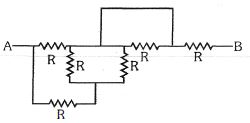
- 3What is the equivalent resistance between $A$ and $B$View Solution
- 4View SolutionThe mechanism of the heat produced in a conductor when an electric current flows through it, can be explained on the basis of
- 5A platinum resistance thermometer has a resistance of $50\,\Omega $ at $20\,^o C$. When dipped in a liquid the resistance becomes $76.8\,\Omega $. The temperature coefficient of resistance for platinum is $\alpha = 3.92 \times {10^{ - 3}}\,^o C$. The temperature of the liquid is .............. $^o C$View Solution
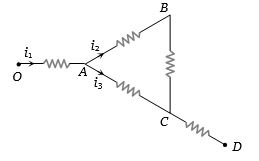
- 6The current in the arm $CD$ of the circuit will beView Solution
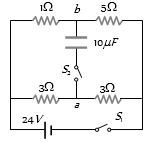
- 7In the circuit shown in figure, switch $S_1$ is initially closed and $S_2$ is open. Find $V_a -V_b$ .............. $V$View Solution
- 8Drift velocity ${v_d}$ varies with the intensity of electric field as per the relationView Solution
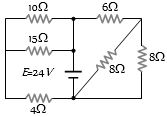
- 9Find the equivalent resistance across the terminals of source of $e.m.f$. $24\, V$ for the circuit shown in figure .............. $\Omega$View Solution
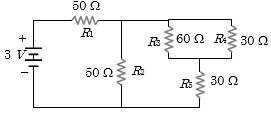
- 10In circuit shown below, the resistances are given in $ohms$ and the battery is assumed ideal with emf equal to $3\, volt$. The voltage across the resistance $R_4$ is ................. $V$View Solution