The mechanism of the heat produced in a conductor when an electric current flows through it, can be explained on the basis of
Easy


Download our appand get started for free
Experience the future of education. Simply download our apps or reach out to us for more information. Let's shape the future of learning together!No signup needed.*
Similar Questions
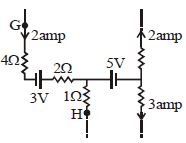
- 1In the part of a circuit shown in the figure, the potential difference $(V_G -V_H)$ between points $G$ and $H$ will be ............... $V$View Solution
- 2Calculate the amount of charge flowing in $2$ minutes in a wire of resistance $10$ $\Omega$ when a potential difference of $20\,V$ is applied between its ends ............ $C$View Solution
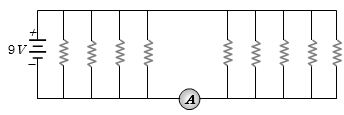
- 3If each resistance in the figure is of $9\,\Omega$ then reading of ammeter is ............ $A$View Solution
- 4The current flowing through a lamp marked as $50\, W$ and $250\, V$ is ............. $amp$View Solution
- 5The current in a conductor is expressed as $I=3 t^2+4 t^3$, where $I$ is in Ampere and $t$ is in second. The amount of electric charge that flows through a section of the conductor during $t=1$ s to $t=2 \mathrm{~s}$ is_______ C.View Solution
- 6View SolutionWhich of the following is vector quantity
- 7When connected across the terminals of a cell, a voltmeter measures $5\,V$ and a connected ammeter measures $10\, A$ of current. A resistance of $2\, ohms$ is connected across the terminals of the cell. The current flowing through this resistance will be ............ $A$View Solution
- 8View SolutionThe potentiometer is best for measuring voltage, as
- 9View SolutionSensitivity of potentiometer can be increased by
- 10In a potentiometer experiment the balancing with a cell is at length $240\,cm$ . On shunting the cell with a resistance of $2\,\Omega $ , the balancing length becomes $120\, cm$ . The internal resistance of the cell is ................... $\Omega$View Solution