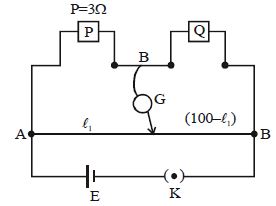
The meter bridge shown is in balanced position with $\frac{\mathrm{P}}{\mathrm{Q}}=\frac{\mathrm{l}_{1}}{\mathrm{l}_{2}}$. If we now litterchange the positions of gavanometer and cell, will the bridge work? If yes, what will be balance condition?
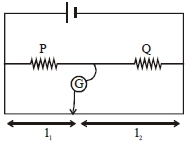
NEET 2019, Medium


Download our appand get started for free
Experience the future of education. Simply download our apps or reach out to us for more information. Let's shape the future of learning together!No signup needed.*
Similar Questions
- 1The resistance of a bulb filmanet is $100\,\Omega$ at a temperature of $100\,^o C$. If its temperature coefficient of resistance be $0.005$ per $^o C$, its resistance will become $200\,\Omega$ at a temperature of ................ $^oC$View Solution
- 2View SolutionWhich of the following statements is false?
- 3View SolutionThe reciprocal of resistance is
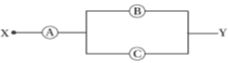
- 4$A, \,B$ and $C$ are voltmeters of resistance $R, \,1 .5R$ and $3R$ respectively as shown in the figure. When some potential difference is applied between $X$ and $Y,$ the voltmeter readings are $V_A, \,V_B$ and $V_C$ respectively. ThenView Solution
- 5If a wire of resistance $20\,\Omega $ is covered with ice and a voltage of $210\, V$ is applied across the wire, then the rate of melting of ice is .................. $g/s$View Solution
- 6If a power of $100\, W$ is being supplied across a potential difference of $200\, V$, current flowing is ............ $A$View Solution
- 7View SolutionBy increasing the temperature, the specific resistance of a conductor and a semiconductor
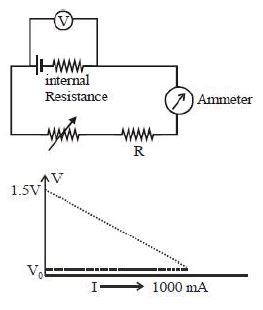
- 8To verify Ohm's law, a student connects the voltmeter across the battery as, shown in the figure. The measured voltage is plotted as a function of the current, and the following graph is obtained If $V_0$ is almost zero, identify the correct statementView Solution
- 9The value of current $i_{1}$ flowing from $A$ to $C$ in the circuit diagram is$.......A$View Solution
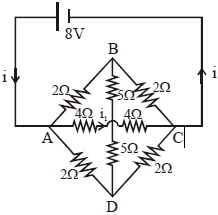
- 10In a meter bridge experiment, resistances are connected as shown in the following figure. The balancing length $l_1$ is $55\, cm$. Now, an unknown resistance $x$ is connected in series with $P$ and the new balancing length is found to be $75\, cm$. The value of $x$ isView Solution