MCQ
The minimum charge on an object is
  • A
    $1$ coulomb
  • B
    $1$ stat coulomb
  • $1.6 \times {10^{ - 19}}$ coulomb
  • D
    $3.2 \times {10^{ - 19}}$ coulomb

Answer

Correct option: C.
$1.6 \times {10^{ - 19}}$ coulomb
c
(c) All other charges are its integral multiple.

Need a full question paper?

Generate a complete, print-ready paper with questions like this in minutes — across 16+ boards, with answer keys.
Start Generating Free

Similar questions

A total charge $q$ is divided as $q_1$ and $q_2$ which are kept at two of the vertices of an equilateral triangle of side a. The magnitude of the electric field $E$ at the third vertex of the triangle is to be depicted schematically as a function of $x=q_1 / q$. Choose the correct figure.
Critical angle is that angle of incidence in the denser medium for which the angle of refraction in rarer medium is......$^o$
Two charges +4e and +e are at a distance x apart. At what distance, a charge q must be placed from charge +e so that it is in equilibrium
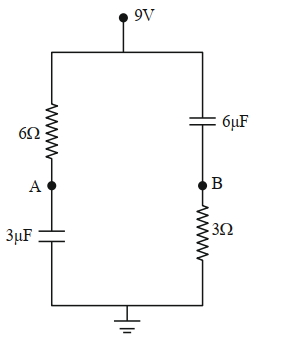
In the given figure, the charge stored in $6 \ \mu \mathrm{F}$ capacitor, when points $A$ and $B$ are joined by a connecting wire is___________ $\mu \mathrm{C}$.
The ratio of specific charge of an $\alpha $ -particle to that of a proton is
A light bulb is rated at $100W$ for a $220V$ supply. Find the peak voltage of the source:
Consider the following statements:
  1. An emf can be induced by moving a conductor in a magnetic field.
  2. An emf can be induced by changing the magnetic field.
A conducting resistor is joined with a battery. If the temperature of the conductor is changed with the cooling process, then the magnitude of current flowing:
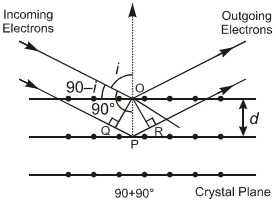
Wave property of electrons implies that they will show diffraction effects. Davisson and Germer demonstrated this by diffracting electrons from crystals. The law governing the diffraction from a crystal is obtained by requiring that electron waves reflected from the planes of atoms in a crystal interfere constructively (see figure).
Which of the following waves have the maximum wavelength