Question
The minimum deviation produced by a hollow prism filled with a certain liquid is found to be $30^o $. The light ray is also found to be refracted at angle of $30^o $. The refractive index of the liquid is

Answer

(a) For minimum angle of deviation for a prism
$A = 2r$, $\therefore $ $A = {60^o}$
Now $\mu = \frac{{\sin \frac{{60 + 30}}{2}}}{{\sin \frac{{60}}{2}}} = \frac{{\sin {{45}^o}}}{{\sin {{30}^o}}} = \frac{1}{{\sqrt 2 }} \times \frac{2}{1} = \sqrt 2 $

Need a full question paper?

Generate a complete, print-ready paper with questions like this in minutes — across 16+ boards, with answer keys.

Start Generating Free

Similar questions

Electric field of plane electromagnetic wave propagating through a non-magnetic medium is given by ${E}=20 \cos \left(2 \times 10^{10} {t}-200 {x}\right) \,{V} / {m} .$ The dielectric constant of the medium is equal to :

(Take $\mu_{{r}}=1$ )

A uniform thin rod $AB$ of length $L$ has linear mass density $\mu \left( x \right) = a + \frac{{bx}}{L}$ , where $x$ is measured from $A$. If the $CM$ of the rod lies at a distance of $\left( {\frac{7}{12}} \right)L$ from $A$, then $a$ and $b$ are related as
Kinetic energy of the emitted $\alpha-$ particle in the $\alpha -$ decay of ${{}_{88}^{226}Ra}$  will be,  .......... $MeV$

(where ${m_\alpha } = 4.00260\,u$, $m\left( {{}_{88}^{226}Ra} \right)=226.02540\,u$ and $m\left( {{}_{86}^{222}Rn} \right)=222.01750\,u)$
A scooter accelerates from rest for time $t_{1}$ at constant rate $a _{1}$ and then retards at constant rate $a _{2}$ for time $t _{2}$ and comes to rest. The correct value of $\frac{t_{1}}{t_{2}}$ will be ..... .
A small ball of mass $m$ and density $\rho$ is dropped in a viscous liquid of density $\rho_0$. After sometime, the ball falls with constant velocity. The viscous force on the ball is:
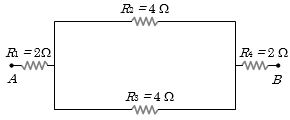
In the given figure, the equivalent resistance between the points $A$ and $B$ is ............ $\Omega$
A drop of liquid of diameter $2.8\, mm$ breaks up into $125$ identical drops. The change in energy is nearly ......... $ergs$ (Surface tension $= 75\, dyne/cm$)
An $X-$ ray tube with a copper target emits Cu ${K_\alpha }$ line of wavelength $1.50 Å.$  What should be the minimum voltage through which electrons are to be accelerated to produce this wavelength of $X-$ rays........$V$ $ (h = 6.63 \times {10^{ - 34}}J{\rm{ - }}\sec ,\;c = 3 \times {10^8}m/s)$
A radioactive nucleus ${ }_{\mathrm{Z}}^{\mathrm{A}} \mathrm{X}$ undergoes spontaneous decay in the sequence

${ }_{\mathrm{Z}}^{\mathrm{A}} \mathrm{X} \rightarrow {}_{\mathrm{Z}-1}{\mathrm{B}} \rightarrow {}_{\mathrm{Z}-3 }\mathrm{C} \rightarrow {}_{\mathrm{Z}-2} \mathrm{D}$, where $\mathrm{Z}$ is the atomic number of element $X.$ The possible decay particles in the sequence are :

Steel wire of length ' $L$ ' at $40^{\circ} C$ is suspended from the ceiling and then a mass ' $m$ ' is hung from its free end. The wire is cooled down from $40^{\circ} C$ to $30^{\circ} C$ to regain its original length ' $L$ '. The coefficient of linear thermal expansion of the steel is $10^{-5} /{ }^{\circ} C$, Young's modulus of steel is $10^{11} N / m ^2$ and radius of the wire is $1 \ mm$. Assume that $L \gg$ diameter of the wire. Then the value of ' $m$ ' in $kg$ is nearly