Question
The minimum frequency $\nu $ of continuous $X-$ rays is related to the applied potential difference $V$ as

Answer

(b)$E = h\nu = eV\, \Rightarrow \,\nu \propto V$

Need a full question paper?

Generate a complete, print-ready paper with questions like this in minutes — across 16+ boards, with answer keys.
Start Generating Free

Similar questions

Two batteries of different $e.m.f.'s$ and internal resistance connected in series with each other and with an external load resistor. The current is $3.0 \,A$. When the polarity of one battery is reversed, the current becomes $1.0 \,A$. The ratio of the $e.m.f.'s$ of the two batteries is ............
In case of an adiabatic process the correct relation in terms of pressure $p$ and density $\rho $ of a gas is
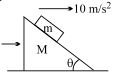
In the figure shown all the surfaces are frictionless, and mass of the block, $m = 1\, kg$. The block and wedge are held initially at rest. Now wedge is given a horizontal acceleration of $10\, m/s^2$ by applying a force on the wedge, so that the block does not slip on the wedge. Then work done by the normal force in ground frame on the block in $\sqrt 3 $ seconds is ......... $J$
Three concentric metal shells $A, B$ and $C$ of respective radii $a, b$ and $c (a < b < c)$ have surface charge densities $+\sigma,-\sigma$ and $+\sigma$ respectively. The potential of shell $B$ is
A capacitor of capacity $C$ has reactance $X$. If capacitance and frequency become double then reactance will be
The field of view is maximum for
An object is placed at $15\, cm$ from convex lens of focal length $20\, cm$, which of the following is correct ?
A buggy of mass $100\, kg$ is free to move on a frictionless horizontal track. Two men, each of mass $50\, kg$, are standing on the buggy, which is initially stationary. The men jump off the buggy with velocity $=10m/s$ relative to the buggy. In one situation, the men jump one after the other. In another situation, the men jump simultaneously. What is the ratio of the recoil velocities of the buggy in two cases?
Two particles of masses $1\ kg$  and $3\ kg$ move towards each other under their mutual force of attraction. No other force acts on them. When the relative velocity of approach of the two particles is $2\ m/s,$ their centre of mass has a velocity of $0.5 \ m/s$. When the relative velocity of approach becomes $3\ m/s,$ the velocity of the centre of mass is ........ $m/s$.
Assertion : A deuteron and an $\alpha -$ particle are placed in an electric field. If $F_1$ and $F_2$ be the forces acting on them and $a_1$ and $a_2$ be their accelerations respectively then, $a_1 = a_2$.

Reason : Forces will be same in electric field