MCQ
The minimum frequency v of continuous X-rays is related to the applied potential difference V as
  • A
    $v ∝ \sqrt v$
  • $v ∝ v$
  • C
    $v ∝ v^{3/2}$
  • D
    $v ∝ v^2$

Answer

Correct option: B.
$v ∝ v$
(b) $v ∝ v$

Need a full question paper?

Generate a complete, print-ready paper with questions like this in minutes — across 16+ boards, with answer keys.
Start Generating Free

Similar questions

Consider the situation shown in figure. If the switch is closed and after some time it is opened again, the closed loop will show:
The phenomena of total internal reflection is seen when angle of incidence is
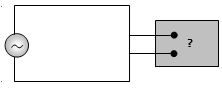
Following figure shows an ac generator connected to a "block box" through a pair of terminals. The box contains possible $R, L, C$ or their combination, whose elements and arrangements are not known to us. Measurements outside the box reveals that $e = 75\, sin\, (sin\, \omega\, t)\, volt,\, i = 1.5\, sin\, (\omega\, t + 45^o)\, amp$ then, the wrong statement is
Pick the correct options.
Orange light of wavelength $6000 \times 10^{-10}\, m$ in illuminates a single slit of width $0.6 \times 10^{-4}\, m$ The maximum possible number of diffraction minima produced on both sides of the central maximum is$........$
A parallel plate capacitor of plate area $A$ and plate separation $d$ is charged to potential $V$ and then the battery is disconnected. A slab of dielectric constant $k$ is then inserted between the plates of the capacitors so as to fill the space between the plates. If $Q,\;E$ and $W$ denote respectively, the magnitude of charge on each plate, the electric field between the plates (after the slab is inserted) and work done on the system in question in the process of inserting the slab, then state incorrect relation from the following
A point charge $+q,$ is placed at a distance d from an isolated conducting plane. The field at a point $P$ on the other side of the plane is:
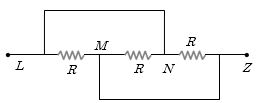
Three equal resistances each of value $R$ are joined as shown in the figure. The equivalent resistance between $M$ and $N$ is
Two circularly shaped linear polarisers are placed coaxially. The transmission axis of the first polariser is at $30^{\circ}$ from the vertical while the second one is at $60^{\circ}$, both in the clockwise sense. If an unpolarised beam of light of intensity $I=20 \,W / m ^{2}$ is incident on this pair of polarisers, then the intensities $I_{1}$ and $I_{2}$ transmitted by the first and second polarisers respectively, will be close to
A long wire A carries a current of $10\, amp$. Another long wire $B$, Which is parallel to $A$ and separated by $0.1\,m$ from $A$, carries a current of $5\, amp$, in the opposite direction to that in $A$. what is the magnitude and nature of the force experienced per unit length of $B$ $({\mu _0} = 4\pi \times {10^{ - 7}}\,weber/amp{\rm{ - }}m)$