MCQ
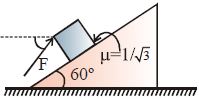
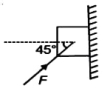
The minimum value of $‘F’$ so that block is in equilibrium is
  • A
    $2mg$
  • B
    $mg$
  • $mg/2$
  • D
    block cannot be in equilibrium

Answer

Correct option: C.
$mg/2$
c
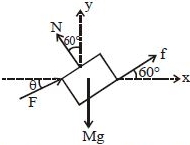
$\Sigma F_{y}=0$

$\mathrm{N} \cos 60^{\circ}+\mathrm{f}_{\mathrm{max}} \sin 60^{\circ}+\mathrm{F} \sin \theta-\mathrm{Mg}=0 \ldots(\mathrm{i})$ 

$\Sigma F_{x}=0$

$\mathrm{f}_{\mathrm{max}} \cos 60^{\circ}+\mathrm{F} \cos \theta-\mathrm{N} \sin 60^{\circ}=0$            $...(ii)$

$f_{\max }=\mu N$                $...(iii)$

$\frac{\mathrm{d} \mathrm{F}}{\mathrm{d} \theta}=0$         $...(iv)$
Need a full question paper?

Generate a complete, print-ready paper with questions like this in minutes — across 16+ boards, with answer keys.
Start Generating Free

Similar questions

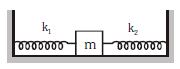
A block of mass $m$ is attached to two springs of spring constants $k_1$ and $k_2$ as shown in figure. The block is displaced by $x$ towards right and released. The velocity of the block when it is at $x/2$ will be
A man carrying a monkey on his shoulder does cycling smoothly on a circular track of radius $9 \mathrm{~m}$ and completes $120$ revolutions in $3$ minutes. The magnitude of centripetal acceleration of monkey is (in $\mathrm{m} / \mathrm{s}^2$ ):
Block $A$ of mass $4 \;kg$ is to be kept at rest against a smooth vertical wall by applying a force $F$ as shown in figure. The force required is .......... $N$ $\left(g=10 m / s ^2\right)$
If mass of a satellite is doubled and time period remain constant the ratio of orbit in the two cases will be
If a graph is plotted by taking spectral emissive power along $y$-axis and wavelength along $x$-axis then the area below the graph above wavelength axis is ...........
A cycle wheel of radius 0.4 m completes one revolution in one second then the acceleration of a point on the cycle wheel will be
Least count of a vernier caliper is $\frac{1}{20 \mathrm{~N}} \mathrm{~cm}$. The value of one division on the main scale is $1 \mathrm{~mm}$. Then the number of divisions of main scale that coincide with $\mathrm{N}$ divisions of vernier scale is :
What is the dimension of Luminous flux
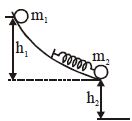
A ball of mass $m_1$ falls from height $h_1$ from rest to strike a spring of force constant $K$, which forces another ball of mass $m_2$ to jump on a horizontal floor at a height $h_2$ below from it. Find the horizontal distance at which ball of mass $m_2$ strikes from the position of start :- [Spring does not move]
Force (F) and density (d) are related as $\text{F}=\frac{\alpha}{\beta+\sqrt{\text{d}}}$
Then, the dimensions of a and B are: