Question
The mixture a pure liquid and a solution in a long vertical column (i.e, horizontal dimensions < < vertical dimensions) produces diffusion of solute particles and hence a refractive index gradient along the vertical dimension. A ray of light entering the column at right angles to the vertical is deviated from its original path. Find the deviation in travelling a horizontal distance d < < h, the height of the column.
Answer

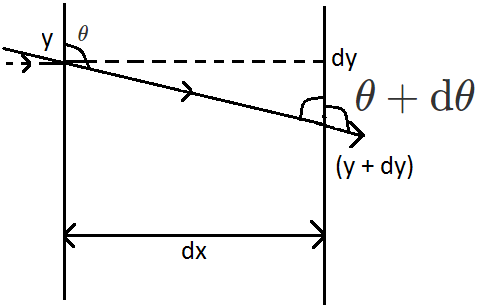
Let us consider a portion of a ray between x and x + dx inside the liquid. Let us suppose the angle of incidence at x be $\theta$ and let it enter the thin column at height y
Because of the bending it shall emerge at x = dx with an angle $\theta+\text{d}\theta$ and at a height y + dy. From Snell's law,

$\mu(\text{y})\sin\theta=\mu(\text{y}+\text{dy})\sin(\theta+\text{d}\theta)$
$\Rightarrow\ \mu(\text{y})\sin\theta=\Big(\mu(\text{y})+\frac{\text{d}\mu}{\text{dy}}\text{dy}\Big)(\sin\theta\cos\text{d}\theta+\cos\theta\sin\text{d}\theta)$
$\big[\because\ \sin(\text{A}+\text{B})=\sin\text{A}\cos\text{B}+\sin\text{B}\cos\text{A}\big]$
Since $\text{d}\theta$ is too small.
Hence, $\cos\text{d}\theta\approx1\text{ and }\text{d}\theta=\text{d}\theta$
$\therefore\ \mu(\text{y})\sin\theta=\Big(\mu(\text{y})+\frac{\text{d}\mu}{\text{dy}}\text{dy}\Big)(\sin\theta+\cos\theta\text{d}\theta)$
$\Rightarrow\ \mu(\text{y})\sin\theta=\mu(\text{y})\sin\theta+\mu(\text{y})\cos\theta\text{d}\theta+\sin\theta\frac{\text{d}\mu}{\text{dy}}\text{dy}+\frac{\text{d}\mu}{\text{dy}}\text{dy}\cos\theta\text{d}\theta$
$\Rightarrow\ \mu(\text{y})\cos\theta\text{d}\theta=-\frac{\text{d}\mu}{\text{dy}}\text{dy}\sin\theta\ \ \bigg[\text{Neglecting}\frac{\text{d}\mu}{\text{dy}}\text{dy}\cos\theta\text{d}\theta\bigg]$
$\Rightarrow\ \text{d}\theta=\frac{-\text{d}\mu}{\mu\text{dy}}\text{dy}\tan\theta$
From the figute, we have $\tan\theta=\frac{\text{dx}}{\text{dy}}$
$\therefore\ \text{d}\theta=\frac{-1\text{d}\mu}{\mu\text{dy}}\text{dx}$
Solving this variable separable from of differential equation, we get
$\therefore\ \theta=\frac{-1\text{d}\mu}{\mu\text{dy}}\int_0^\text{d}\text{dx}=\frac{-1\text{d}\mu}{\mu\text{dy}}\text{d}$

Need a full question paper?

Generate a complete, print-ready paper with questions like this in minutes — across 16+ boards, with answer keys.

Start Generating Free

Similar questions

Consider the situation shown in figure. The switch S is open for a long time and then closed:
  1. Find the charge flown through the battery when the switch S is closed.
  2. Find the work done by the battery.
  3. Find the change in energy stored in the capacitors.
  4. Find the heat developed in the system.
A copper wire of radius 0.1mm and resistance $1\text{k}\Omega$ is connected across a power supply of 20V.
(a) How many electrons are transferred per second between the supply and the wire at one end? (b) Write down the current density in the wire.
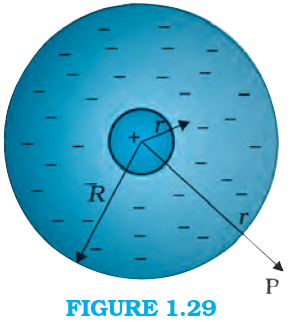
An early model for an atom considered it to have a positively charged point nucleus of charge $Z e$, surrounded by a uniform density of negative charge up to a radius $R$. The atom as a whole is neutral. For this model, what is the electric field at a distance $r$ from the nucleus?
Image
What is meant by electric potential? Calculate the electric potential generated by a point charge. Draw the equipotential surfaces resulting from this.
A suitcase kept on a shop's rack is measured 50cm × 25cm × 10cm by the shop's owner. A traveller takes this suitcase in a train moving with velocity 0.6c.
If the suitcase is placed with its length along the train's velocity, find the dimensions measured by:
  1. The traveller and.
  2. A ground observer.
An atom is in its excited state. Does the probability of its coming to ground state depend on whether the radiation is already present or not? If yes, does it also depend on the wavelength of the radiation present?
The image of a small electric bulb fixed on the wall of a room is to be obtained on the opposite wall 3 m away by means of a large convex lens. What is the maximum possible focal length of the lens required for the purpose?
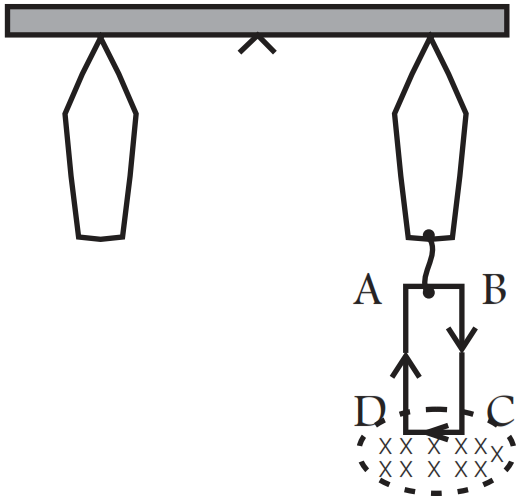
A $100$ turn rectangular coil $\text{ABCD} ($in $XY$ plane$)$ is hung from one arm of a balance $($Fig$). A$ mass $500g$ is added to the other arm to balance the weight of the coil. $A$ current $4.9A$ passes through the coil and a constant magnetic field of $0.2T$ acting inward $($in $xz$ plane$)$ is switched on such that only arm $CD$ of length $1\ cm$ lies in the field. How much additional mass $'m\ '$ must be added to regain the balance?
Two charges q and -3q are placed fixed on x-axis separated by distance 'd'. Where should a third charge 2q be placed such that it will not experience any force?
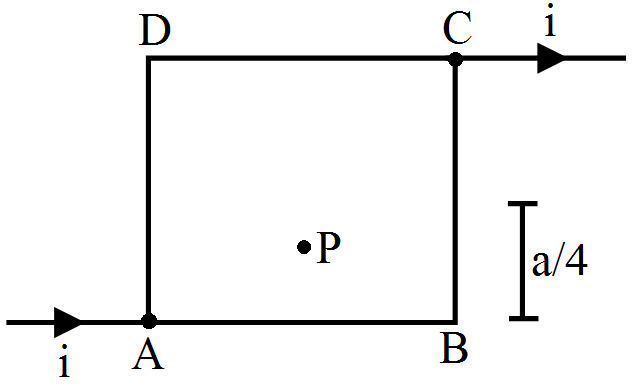
Figure shows a square loop of edge a made of a uniform wire. A current i enters the loop at the point A and leaves it at the point C. Find the magnetic field at the point P which is on the perpendicular bisector of AB at a distance $\frac{\text{a}}{4}$ from it.