Question
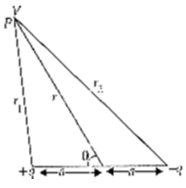
What is meant by electric potential? Calculate the electric potential generated by a point charge. Draw the equipotential surfaces resulting from this.

Answer

SELF

Need a full question paper?

Generate a complete, print-ready paper with questions like this in minutes — across 16+ boards, with answer keys.
Start Generating Free

Similar questions

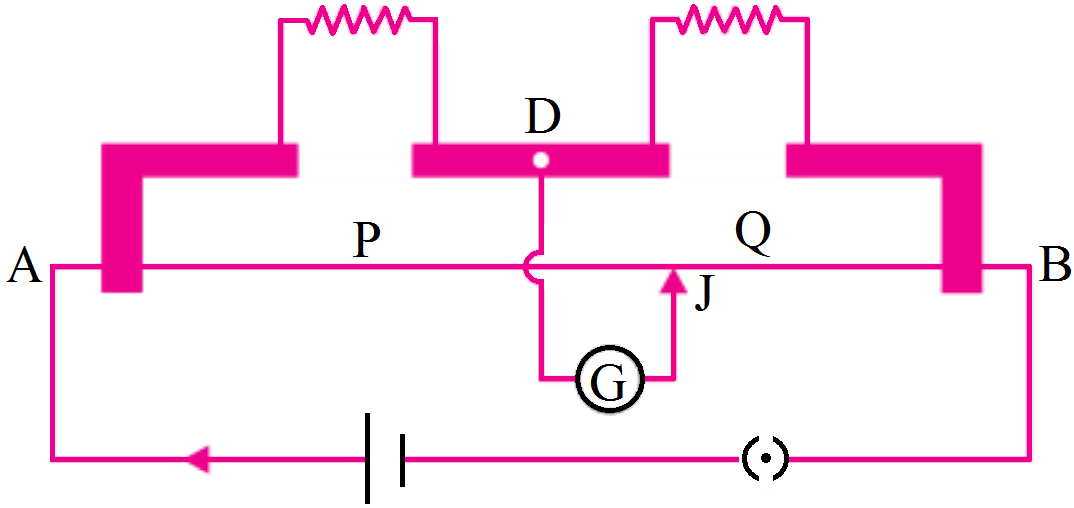
In a practical Wheatstone bridge circuit, wire $AB$ is $2\ m$ long. When resistance $Y = 2.0W$ and jockey is in position $J$ such that $AJ = 1.20\ m$, there is no current in galvanometer, find the value of unknown resistance $X$. The resistance per unit length of wire $AB = 0.01W/ cm$. Also calculate the current drawn by the cell of emf $4.0V$ and negligible internal resistance.
Derive the lens formula $\frac{1}{\text{f}}=\frac{1}{\text{v}}-\frac{1}{\text{u}}$ for a thin concave lens, using the necessary ray diagram.
A spherical ball $A$ of surface area $20\ cm^2$ is kept at the centre of a hollow spherical shell $B$ of area $80\ cm^2.$ The surface of $A$ and the inner surface of $B$ emit as blackbodies. Both $A$ and $B$ are at $300K.$
  1. How much is the radiation energy emitted per second by the ball $A?$
  2. How much is the radiation energy emitted per second by the inner surface of $B$
  3. How much of the energy emitted by the inner surface of $B$ falls back on this surface itself?
Solve the previous problem if the coefficient of restitution is e. Use $\theta=45^\circ,\ \text{e}=\frac{3}{4}$ and h = 5m
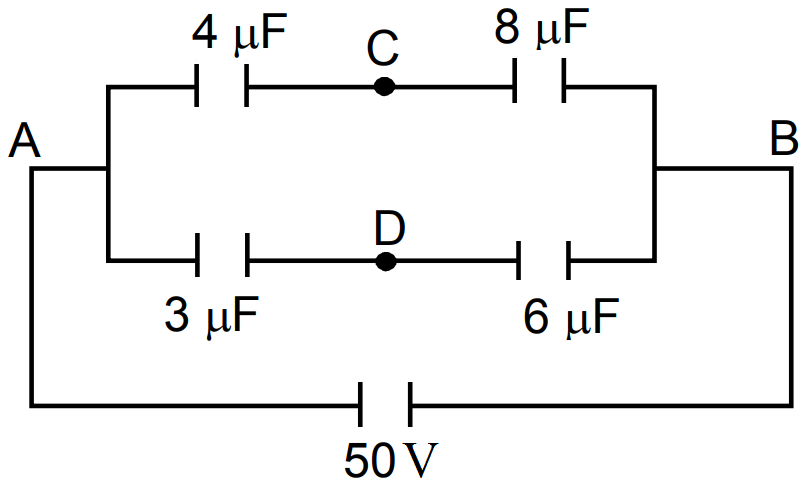
Take the potential of the point B in figure to be zero:
  1. Find the potentials at the points C and D.
  2. If a capacitor is connected between C and D, what charge will appear on this capacitor?
A beam of white light is incident normally on a plane surface absorbing 70% of the light and reflecting the rest. If the incident beam carries 10W of power, find the force exerted by it on the surface.
Suppose the friction coefficient between the ground and the ladder of the previous problem is 0.540. Find the maximum weight of a mechanic who could go up and do the work from the same position of the ladder.
Derive an expression for potential due to a dipole for distances large compared to the size of the dipole. How is the potential due to dipole different from that due to a single charge?
Image
Two ideal gases have the same value of $\frac{\text{C}_\text{P}}{\text{C}_\text{V}}=\gamma.$ What will be the value of this ratio for a mixture of the two gases in the ratio $1 : 2?$
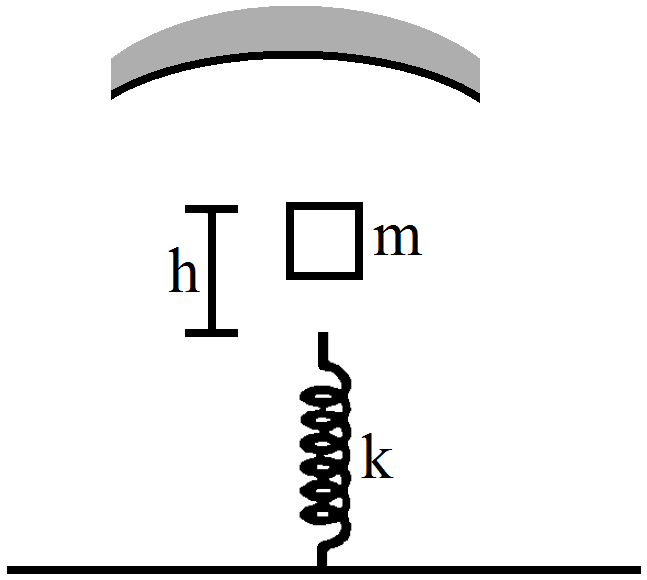
A mass $m = 50g$ is dropped on a vertical spring of spring constant $500\ N/m$ from a height $h = 10\ cm$ as shown in figure. The mass sticks to the spring and executes simple harmonic oscillations after that. A concave mirror of focal length $12\ cm$ facing the mass is fixed with its principal axis coinciding with the line of motion of the mass, its pole being at a distance of $30\ cm$ from the free end of the spring. Find the length in which the image of the mass oscillates.