Question
The mixture a pure liquid and a solution in a long vertical column (i.e, horizontal dimensions < < vertical dimensions) produces diffusion of solute particles and hence a refractive index gradient along the vertical dimension. A ray of light entering the column at right angles to the vertical is deviated from its original path. Find the deviation in travelling a horizontal distance d < < h, the height of the column.
Answer

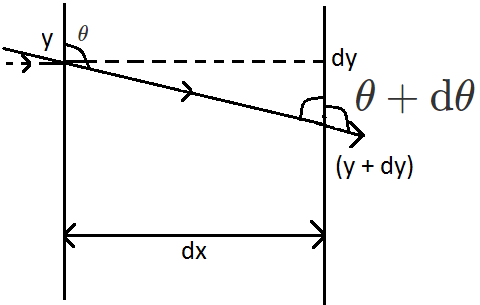
Let us consider a portion of a ray between x and x + dx inside the liquid. Let us suppose the angle of incidence at x be $\theta$ and let it enter the thin column at height y
Because of the bending it shall emerge at x = dx with an angle $\theta+\text{d}\theta$ and at a height y + dy. From Snell's law,

$\mu(\text{y})\sin\theta=\mu(\text{y}+\text{dy})\sin(\theta+\text{d}\theta)$
$\Rightarrow\ \mu(\text{y})\sin\theta=\Big(\mu(\text{y})+\frac{\text{d}\mu}{\text{dy}}\text{dy}\Big)(\sin\theta\cos\text{d}\theta+\cos\theta\sin\text{d}\theta)$
$\big[\because\ \sin(\text{A}+\text{B})=\sin\text{A}\cos\text{B}+\sin\text{B}\cos\text{A}\big]$
Since $\text{d}\theta$ is too small.
Hence, $\cos\text{d}\theta\approx1\text{ and }\text{d}\theta=\text{d}\theta$
$\therefore\ \mu(\text{y})\sin\theta=\Big(\mu(\text{y})+\frac{\text{d}\mu}{\text{dy}}\text{dy}\Big)(\sin\theta+\cos\theta\text{d}\theta)$
$\Rightarrow\ \mu(\text{y})\sin\theta=\mu(\text{y})\sin\theta+\mu(\text{y})\cos\theta\text{d}\theta+\sin\theta\frac{\text{d}\mu}{\text{dy}}\text{dy}+\frac{\text{d}\mu}{\text{dy}}\text{dy}\cos\theta\text{d}\theta$
$\Rightarrow\ \mu(\text{y})\cos\theta\text{d}\theta=-\frac{\text{d}\mu}{\text{dy}}\text{dy}\sin\theta\ \ \bigg[\text{Neglecting}\frac{\text{d}\mu}{\text{dy}}\text{dy}\cos\theta\text{d}\theta\bigg]$
$\Rightarrow\ \text{d}\theta=\frac{-\text{d}\mu}{\mu\text{dy}}\text{dy}\tan\theta$
From the figute, we have $\tan\theta=\frac{\text{dx}}{\text{dy}}$
$\therefore\ \text{d}\theta=\frac{-1\text{d}\mu}{\mu\text{dy}}\text{dx}$
Solving this variable separable from of differential equation, we get
$\therefore\ \theta=\frac{-1\text{d}\mu}{\mu\text{dy}}\int_0^\text{d}\text{dx}=\frac{-1\text{d}\mu}{\mu\text{dy}}\text{d}$

Need a full question paper?

Generate a complete, print-ready paper with questions like this in minutes — across 16+ boards, with answer keys.

Start Generating Free

Similar questions

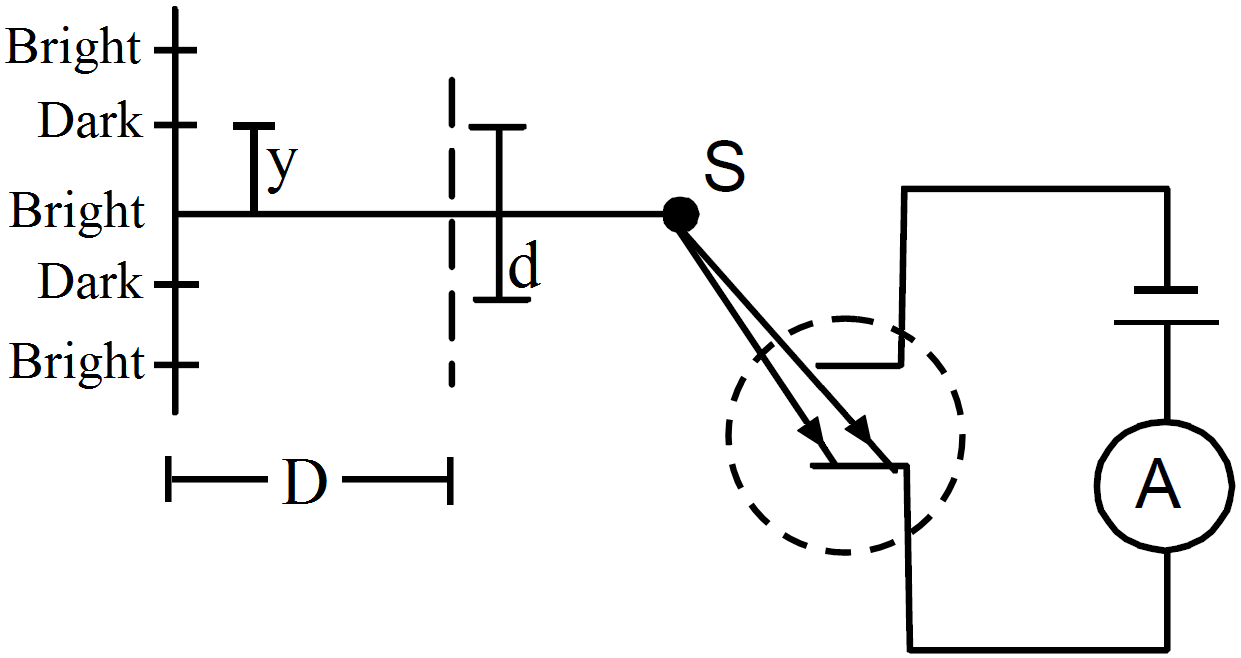
In the arrangement shown in figure y = 1.0mm. d = 0.24mm end D = 1.2m. The work function of the materiel of the emitter is 2.2eV. Find the stopping potential V needed to stop the photocurrent.

Find the current through the battery circuits shown in figure.

A capacitor of capacitance $12.0\mu\text{F}$ is connected to a battery of emf 6.00V and internal resistance $1.00\Omega$ through resistanceless leads. $12.0\mu\text{s}$ after the connections are made, what will be (a) the current in the circuit (b) the power delivered by the battery (c) the power dissipated in heat and (d) the rate at which the energy stored in the capacitor is increasing.
Figure. shows two vessels A and B with rigid walls containing ideal gases. The pressure, temperature and the volume are pA, TA, V in the vessel A and pB, TB, V in the vessel B. The vessels are now connected through a small tube. Show that the pressure p and the temperature T satisfy $\frac{\text{p}}{\text{T}}=\frac{1}{2}\Big(\frac{\text{P}_\text{A}}{\text{T}_\text{A}}+\frac{\text{p}_\text{B}}{\text{T}_\text{B}}\Big)$ when equilibrium is achieved.

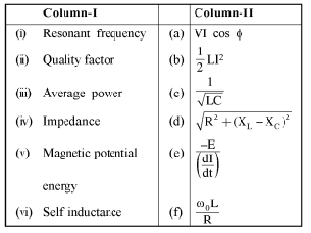
Match the following
Image
An operator sitting in his base camp sends a sound signal of frequency 400Hz. The signal is reflected back from a car moving towards him. The frequency of the reflected sound is found to be 410Hz. Find the speed of the car. Speed of sound in air = 324m/s.
The current in a discharging LR circuit without the battery drops from 2.0A to 1.0A in 0.10s.
  1. Find the time constant of the circuit.
  2. If the inductance of the circuit is 4.0H, what is its resistance?
How many time constants will elapse before the energy stored in the capacitor reaches half of its equilibrium value in a charging RC circuit?
The amplifiers X, Y and Z are connected in series. If the voltage gains of X, Y and Z are 10, 20 and 30, respectively and the input signal is 1 mV peak value, then what is the output signal voltage (peak value):
  1. If dc supply voltage is 10V?
  2. If dc supply voltage is 5V?
Take the potential of the point B in figure to be zero:
  1. Find the potentials at the points C and D.
  2. If a capacitor is connected between C and D, what charge will appear on this capacitor?