MCQ
The modulus of elasticity is dimensionally equivalent to
  • A
    Surface tension
  • Stress
  • C
    Strain
  • D
    None of these

Answer

Correct option: B.
Stress
b
(b) Hookes law establishes the relationship between stress and strain

Stress$:$ The force per unit area

Strain$:$ The elongation or contraction per unit length (dimensionless)

The ratio of stress to strain is known as the elastic modulus of the material

Elastic Modulus $=\frac{\text {stress}}{\text {strain}}$ Hence, the modulus of elasticity is dimensionally equivalent to the stress

Need a full question paper?

Generate a complete, print-ready paper with questions like this in minutes — across 16+ boards, with answer keys.
Start Generating Free

Similar questions

A source of sound of frequency $n$ is moving towards a stationary observer with a speed $S.$ If the speed of sound in air is $V$ and the frequency heard by the observer is ${n_1}$, the value of ${n_1}/n$ is
Gas obey $P^2V =$ constant. The initial temperature and volume are $T_0$ and $V_0$. If gas expands to volume $2V_0$, the final temp is
If a unit vector is represented by $0.5\hat i + 0.8\hat j + c\hat k$, then the value of ‘$c$’ is
A particle has initial velocity of $\left( {\widehat i + \widehat j} \right)\, m/s$ and an acceleration of $\left( {\widehat i + \widehat j} \right)\, m/s^2$. Its speed after $10s$ will be :-
Choose the incorrect statement from the following
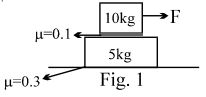
When $F = 2N$, the frictional force between $5 kg$ block and ground is ...... $N$
One large soap bubble of diameter D breaks into 27 bubbles having surface tension T. The change in surface energy is
A ball moving with velocity $2 \,m/s$ collides head on with another stationary ball of double the mass. If the coefficient of restitution is $0.5,$ then their velocities after collision will be
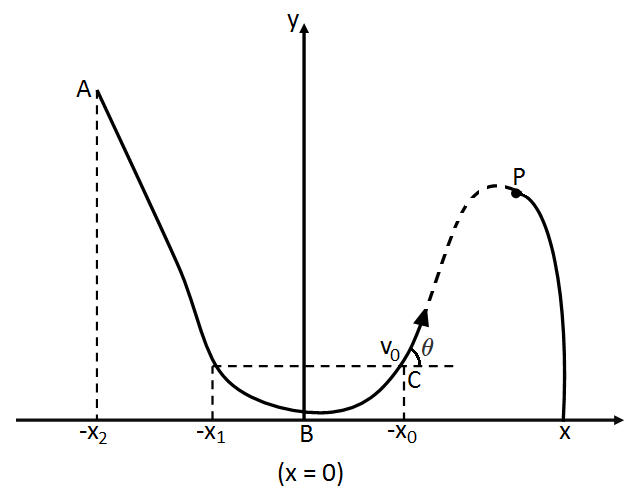
A particle slides down a frictionless parabolic $\left(y=x^2\right)$ track $(A-B-C)$ starting from rest at point $A$. Point $B$ is at the vertex of parabola and point $C$ is at a height less than that of point $A$. After $C$, the particle moves freely in air as a projectile. If the particle reaches highest point at $P$, then
A solid sphere is rotating freely about its symmetry axis in free space. The radius of the sphere is increased keeping its mass same. Which of the following physical quantities would remain constant for the sphere $?$