$NH_4NO_{3(s)} \to N_2O_{(g)} + 2H_2O_{(l)}$ .....$kJ$
- A$-122.56$
- ✓$-125.04$
- C$-140.34$
- D$-112.04$
$NH_4NO_{3(s)} \to N_2O_{(g)} + 2H_2O_{(l)}$ .....$kJ$
$\Delta {\text{H}} = {\left( {\Delta {{\text{H}}_{\text{f}}}} \right)_{{{\text{N}}_2}{{\text{O}}_{({\text{g}})}}}} + 2 \times {\left( {\Delta {{\text{H}}_{\text{f}}}} \right)_{{H_2}{O_{(l)}}}} - {\left( {\Delta {{\text{H}}_{\text{f}}}} \right)_{{\text{N}}{{\text{H}}_4}{\text{N}}{{\text{O}}_{3(s)}}}}$
$ = - 122.56\,{\text{kJ}}$
$\Delta {\text{H}} = \Delta {\text{U}} + \Delta {{\text{n}}_{\text{g}}}{\text{RT}}$
$\Delta {\text{U}} = \Delta {\text{H}} - \Delta {{\text{n}}_{\text{g}}}{\text{RT}}$
$ = - 125.04\,{\text{kJ}}$
Generate a complete, print-ready paper with questions like this in minutes — across 16+ boards, with answer keys.
$C{H_3} - C{H_2} - CH = C{H_2}\xrightarrow[{{H_2}{O_2}}]{{HBr}}$
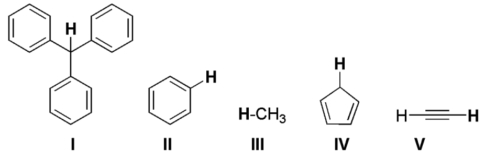
$(A)$ The acidity of compound $I$ is due to delocalization in the conjugate base.
$(B)$ The conjugate base of compound IV is aromatic.
$(C)$ Compound II becomes more acidic, when it has a $- NO _2$ substituent.
$(D)$ The acidity of compounds follows the order $I > IV > V > II > III$.
$[CH_3CH(CH_3)]_2 \,C(CH_2CH_3)C(CH_3) C(CH_2CH_3)_2$