MCQ
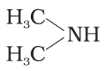
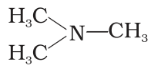
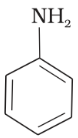
The most reactive amine towards dilute hydrochloric acid is __________.
 
  • A
    $\mathrm{CH_3-NH_2}$
  • C
  • D

Answer

Correct option: B.
​​​
The greater will be the strength of base, the greater will be its reactivity towards dilute HCl. Hence, $(CH_3)_2NH$ has the highest basic strength as it has the highest reactivity.

Need a full question paper?

Generate a complete, print-ready paper with questions like this in minutes — across 16+ boards, with answer keys.
Start Generating Free

Similar questions

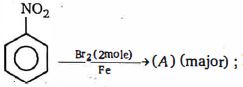
Product $(A)$ will be
Acid hydrolysis of which of the following compounds yields two different organic compounds?
The spin only magnetic moments (in $BM$) for free $\mathrm{Ti}^{3+}, \mathrm{V}^{2+}$ and $\mathrm{Sc}^{3+}$ ions respectively are (At.No. $Sc: 21; Ti : 22; V : 23)$
Which of the following expressions correctly represents the equivalent conductance at are the equivalent conductances infinite dilution of $Al_2(SO_4)_3 .$ Given that $\mathop {{\Lambda _{A{l^{3 + }}}}}\limits^{o\,\,\,\,\,\,\,\,\,\,\,\,\,} $ and $\mathop {{\Lambda _{SO_4^{2 - }}}}\limits^{o\,\,\,\,\,\,\,\,\,\,\,} $ are the equivalent conductances at infinite dilution of the respective ions?
$C{H_3}C{H_2}OH\xrightarrow{{\operatorname{Re} dP + {I_2}}}\left( A \right)\xrightarrow[{Ether}]{{Mg}}\left( B \right)\xrightarrow{{HCHO}}\left( C \right)\xrightarrow{{{H_2}O}}\left( D \right)$

The compound $(D)$ is

In basic medium $CrO _{4}^{2-}$ oxidises $S _{2} O _{3}^{2-}$ to form $SO _{4}^{2-}$ and itself changes into $Cr ( OH )_{4}^{-}$. The volume of $0.154\, M CrO _{4}^{2-}$ required to react with $40\, mL$ of $0.25\, M S _{2} O _{3}^{2-}$ is ........... $mL$

(Rounded-off to the nearest integer)

Affinity for hydrogen decreases in the group from fluorine to iodine. Which of the halogen acids should have highest bond dissociation enthalpy?
$\operatorname{Zr}\,(\mathrm{Z}=40)$ and $\mathrm{Hf}\,(\mathrm{Z}=72)$ have similar atomic and ionic radii because of :
$(A)\xrightarrow[\Delta ]{{N{H_2}OH}}$ $(B)\xrightarrow{{{H_2}S{O_4}}}$ $(C)\xrightarrow{{{H_3}{O^ \oplus }}}$ $(D) + (E)\xrightarrow[{KOH,\,\Delta }]{{CHC{l_3}}}$ $C{H_3} - N\vec  = C$

$(D)\xrightarrow{{SOC{l_2}}}(F)$ $\xrightarrow[{(ii)\,{H^ \oplus }}]{{(i)\,phMgBr\,(excess)}}(G)\,$ $\xrightarrow[\Delta ]{{{H^ \oplus }}}(H)\xrightarrow[{Zn/Cu}]{{C{H_2}{I_2}}}$ figure

Molecular weight of compound $(A)$ is

Methylphenyl ether can be obtained by reacting