MCQ
The most stable oxidation state of $Cr$ in aq. medium is
  • A
    $Cr^{2+}$
  • $Cr^{3+}$
  • C
    $Cr^{4+}$
  • D
    $Cr^{6+}$

Answer

Correct option: B.
$Cr^{3+}$
b

Need a full question paper?

Generate a complete, print-ready paper with questions like this in minutes — across 16+ boards, with answer keys.
Start Generating Free

Similar questions

The reaction of toluene with chlorine in the presence of ferric chloride gives predominantly:
Choose the correct statement
Molecular formula of amyl alcohol is
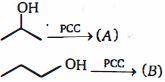
$(A)$ and $(B)$ is differentiated by
The electrodes of a conductivity cell are $3\,cm$ apart and have a cross-sectional area of $4\,c{m^2}$. The cell constant of the cell (in $c{m^{ - 1}}$) is
The reaction $A + B\xrightarrow{k}$ product is first order with respect to $A$ and zero order with respect to $B$. If $b_0$ and $b_t$ are the concentration of $B$ at $t = 0$ and after time $t\, sec$ respectively the select the correct relationship -
  Column $-I$ (various
solutions)
  Column $-II$
(Their freezing
point )
$a$ $0.1\,M$ $BaCl_2$ solution $p$ $271\,K$
$b$ $0.1\,M$ $NaCl$ solution $q$ $270\,K$
$c$ $0.1\,M\, K_3 [Fe(CN)_6]$ solution $r$ $268\,K$
$d$ $0.1\,M\, Al_2 (SO_4)_3$ solution $s$ $269\,K$

Given : Freezing point of $0.1\,M$ sucrose solution $= 272\,K$ and $F.pt.$ of water $= 273\,K$ 

Which of the following option show correct matches ?
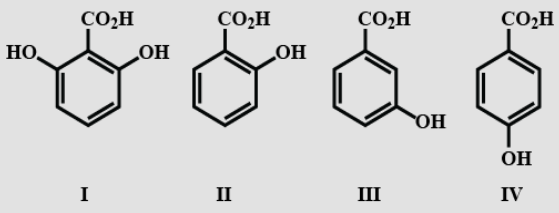
The order of acidity for the following compounds is:
The total number of unpaired electrons present in $\left[\mathrm{Co}\left(\mathrm{NH}_{3}\right)_{6}\right] \mathrm{Cl}_{2}$ and $\left[\mathrm{Co}\left(\mathrm{NH}_{3}\right)_{6}\right] \mathrm{Cl}_{3}$ is $......$
Given that $\frac{1}{3}\mathop {{\lambda _m}}\limits^\infty  \left( {F{e^{3 + }}} \right) = 68\,oh{m^{ - 1}}\,c{m^{ - 1}}\,e{q^{ - 1}}$ and $\frac{1}{2}\mathop {{\lambda _m}}\limits^\infty  \left( {SO_4^{2 - }} \right) = 80\,oh{m^{ - 1}}\,c{m^{ - 1}}\,e{q^{ - 1}}$ What will be value of $\mathop {{\lambda _{eq}}}\limits^\infty  \left( {F{e_2}{{\left( {S{O_4}} \right)}_3}} \right)$ ? ............ ${\rm{oh}}{{\rm{m}}^{ - 1}}{\mkern 1mu} {\rm{c}}{{\rm{m}}^2}$ $\mathrm{eq}^{-1}$