MCQ
The most volatile compound is
  • $2, 2-$ dimethyl propane
  • B
    $2-$ methyl butane
  • C
    Isobutane
  • D
    $n-$ pentane

Answer

Correct option: A.
$2, 2-$ dimethyl propane
a
The boiling point is inversely proportional to the branch in the compound. Therefore, $2,2$-dimethyl propane has more branching, higher boiling point.

Need a full question paper?

Generate a complete, print-ready paper with questions like this in minutes — across 16+ boards, with answer keys.

Start Generating Free

Similar questions

The equilibrium $PC{l_5}_{(g)\,}\, \rightleftharpoons \,PC{l_3}_{(g)} + \,C{l_{2(g)}}$ shows that $K_P\,(atm)$ is double to the value of $K_C$ $(mol/litre)$ at a particular temperature $T,$ then $T$ is ......$K$
$N_2H_4 + IO_3^ -+ 2H^+ + Cl^-\to ICl + N_2 + 3H_2O$

The equivalent masses of $N_2H_4$ and $KIO_3$ respectively are

Given 

$(A)$ $2 CO ( g )+ O _2( g ) \rightarrow 2 CO _2( g ) \quad \Delta H _1^\theta=- x\,kJ\,mol { }^{-1}$

$(B)$ $C$ (graphite) $+ O _2$ (g) $\rightarrow CO _2$ (g) $\Delta H _2^\theta=- y\,kJ\,mol -1$ The $\Delta H ^\theta$ for the reaction $......$.$C ($ graphite $)+\frac{1}{2} O _2( g ) \rightarrow CO ( g )$ is
Which of the following compounds is not aromatic?
Among the following acids, the strongest acid is
The $IUPAC$ nomenclature of an element with electronic configuration $[ Rn ] 5 f ^{14} 6 d ^{1} 7 s ^{2}$ is.
Suppose two elements $X$ and $Y$ combine to form two compounds $XY_2$ and $X_2Y_3$. If $0.05$ mole of $XY_2$ weighs $5\, g$ while $3.011 \times 10^{23}$ molecules of $X_2Y_3$ weighs $85\, g$, then atomic masses of $X$ and $Y$ are respectively :
$HCl$ is a gas but $HF$ is a low boiling liquid. This is because
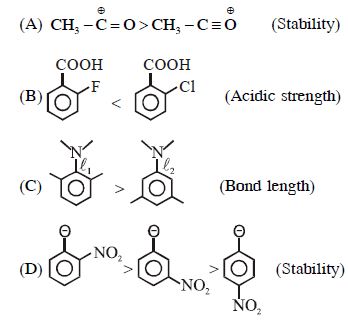
Which are correct order


For $F_2$ and $OF$ molecules consider the following statements 
$(a)$ Bond order for both is one
$(b)$ $OF$ is paramagnetic but $F_2$ is diamagnetic
$(c)$ $F_2$ is more likely to dissociate into atoms than $OF$
$(d)$ Both have greater number of electrons in $BMO$ than that in $ABMO$
Which of the following statements are true $(T)$ or false $(F)$ respectively