Question
The motion of a torsional pendulum is:
  1. Periodic.
  2. Oscillatory.
  3. Simple harmonic.
  4. Angular simple harmonic.

Answer

  1. Periodic.
  1. Oscillatory.
  1. Angular simple harmonic.

Explanation:

Because it completes one oscillation in a fixed interval of time and the oscillations are in terms of rotation of the body through some angle.

Need a full question paper?

Generate a complete, print-ready paper with questions like this in minutes — across 16+ boards, with answer keys.

Start Generating Free

Similar questions

A standing wave is represented by

$Y = A\sin (100t)\cos (0.01x)$

where $Y$ and $A$ are in millimetre, $t$ is in seconds and $x$ is in metre. The velocity of wave is ..... $m/s$
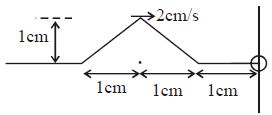
A trianguler pulse moving at $2\ cm/s$ on a rope approches an end at which it is free to slide on vertical pole. What is the particle speed at the free end at $\frac{3}{4}\  sec$  from the instant shown ...... $cm/s$
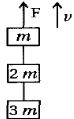
Three blocks with masses $m, 2m $ and $3 m$ are connected by strings, as shown in the figure. After an upward force $F$ is applied on block $m,$ the masses move upward at constant speed $v.$ What is the net force on the block of mass $2\ m\ ?\, (g$ is the acceleration due to gravity$)$
During a negative beta decay:
  1. An atomic electron is ejected.
  2. An electron which is already present within the nucleus is ejected.
  3. A neutron in the nucleus decays emitting an electron.
  4. A proton in the nucleus decays emitting an electron.
Water flows in a stream line manner through a capillary tube of radius $a$. The pressure difference being $P$ and the rate of flow is $Q$. If the radius is reduced to $\frac{a}{4}$ and the pressure is increased to $4 P$. then the rate of flow becomes ................
At what point of a projectile motion acceleration and velocity are perpendicular to each other
The equation of a certain gas can be written as: ${\left( {\frac{{{T^7}}}{{{P^2}}}} \right)^{1/5}} = $ constant. The specific heat at constant volume of this gas is in $\left( {in\frac{J}{{mol\,K}}} \right)$
What is number of degrees of freedom of an ideal diatomic molecule at ordinary temperature?
Two resistors of resistances $R_1 = (300 \pm 3) \,\Omega $ and $R_2 = (500 \pm 4)$ are connected in series. The equivalent resistance of the series combination is
In a hydrogen atom, the distance between the electron and proton is $2.5 \times {10^{ - 11}}\,m$. The electrical force of attraction between them will be