MCQ
The nature of electromagnetic wave is :-
  • A
    longitudinal
  • B
    longitudinal stationary
  • transverse
  • D
    transverse stationary

Answer

Correct option: C.
transverse
c
Electromagnetic waves are transverse. The are moving with a certain phase velocity $v =\frac{\omega}{ k }$. Thus they are not stationary.

Need a full question paper?

Generate a complete, print-ready paper with questions like this in minutes — across 16+ boards, with answer keys.

Start Generating Free

Similar questions

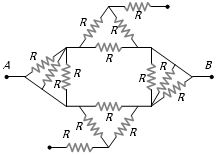
Find equivalent resistance between $A$ and $B$
Consider three point objects $P, Q$ and $R \cdot P$ and $Q$ repel each other, while $P$ and $R$ attract. What is the nature of force between $Q$ and $R$ ?
An emf of $20\; \mathrm{V}$ is applied at time $\mathrm{t}=0$ to a circuit containing in series $10\; \mathrm{mH}$ inductor and $5 \;\Omega$ resistor. The ratio of the currents at time $\mathrm{t}=\infty$ and at $t=40\; s$ is close to : (Take $e^{2}=7.389$ )
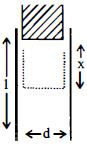
A parallel plate capacitor is made of two plates of length $l$, width $w$ and separated by distance $d$. A dielectric slab ( dielectric constant $K$) that fits exactly between the plates is held near the edge of the plates. It is pulled into the capacitor by a force $F = -\frac{{\partial U}}{{\partial x}}$ where $U$ is the energy of the capacitor when dielectric is inside the capacitor up to distance $x$ (See figure). If the charge on the capacitor is $Q$ then the force on the dielectric when it is near the edge is
The change in frequency due to Doppler effect does not depend on:
A capacitor works in:
The nuclear activity of a radioactive element becomes $\left(\frac{1}{8}\right)^{\text {th }}$ of its initial value in $30\, years.$ The half-life of radioactive element is $....\,years.$
The resistance of a wire of uniform diameter d and length L is R. The resistance of another wire of the same material but diameter 2d and length 4L will be
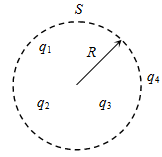
$q1,q2,q3$ and $q4$ are point charges located at points as shown in the figure and S is a spherical Gaussian surface of radius R. Which of the following is true according to the Gauss’s law
With increase in frequency of an $a.c.$ supply, the impedance of an $L C R$ series circuit