Question
The nucleus $^{23}_{10}\text{Ne}$ decays by $\beta$ emission. Write down the $\beta$-decay equation and determine the maximum kinetic energy of the electrons emitted. Given that:
$\text{m}(^{23}_{10}\text{Ne})=22.994466\text{ u}.$
$\text{m}(^{23}_{10}\text{Na})=22.089770\text{ u}.$

Answer

The $\beta$-decay of $^{23}_{10}\text{Ne}$ may be represented as:
$^{23}_{10}\text{Ne}\rightarrow\ ^{23}_{11}\text{Na }\ -\ ^{0}_{-1}\text{e }\ +\ \overline{\text{v}}\ +\ \text{Q}$
Ignoring the rest mass of antineutrino $(\overline{\text{v}})$ and electron, we get Mass defect,
$\Delta\text{m}=\text{m}(^{23}_{10}\text{Ne})-\text{m}(^{23}_{11}\text{Na})$
= 22.994466 - 22.989770
= 0.004696 u
$\therefore\ \text{Q}=0.004696\times931\text{ MeV}=4.372\text{ MeV}.$
This energy of 4.3792 MeV, is shared by e- and $\overline{\text{v}}$ pair because, $^{23}_{11}\text{Na}$ is very massive.
The maximum K.E. of e- = 4.372 MeV, when energy carried by $\overline{\text{v}}$ is zero.

Need a full question paper?

Generate a complete, print-ready paper with questions like this in minutes — across 16+ boards, with answer keys.

Start Generating Free

Similar questions

  1. Three photo diodes D1 , D2 and D3 are made of semiconductors having band gaps of 2.5eV, 2eV and 3eV respectively. Which of them will not be able to detect light of wavelength 600nm?
  2. Why photodiodes are required to operate in reverse bias? Explain.
Figure. shows three paths through which a gas can be taken from the state A to the state B. Calculate the work done by the gas in each of the three paths.

Can we find the mass of a photon by the definition p = mv?
In hydrogen atom, there is single electron only but many lines in its emission spectrum. How it does? Explain the reason.
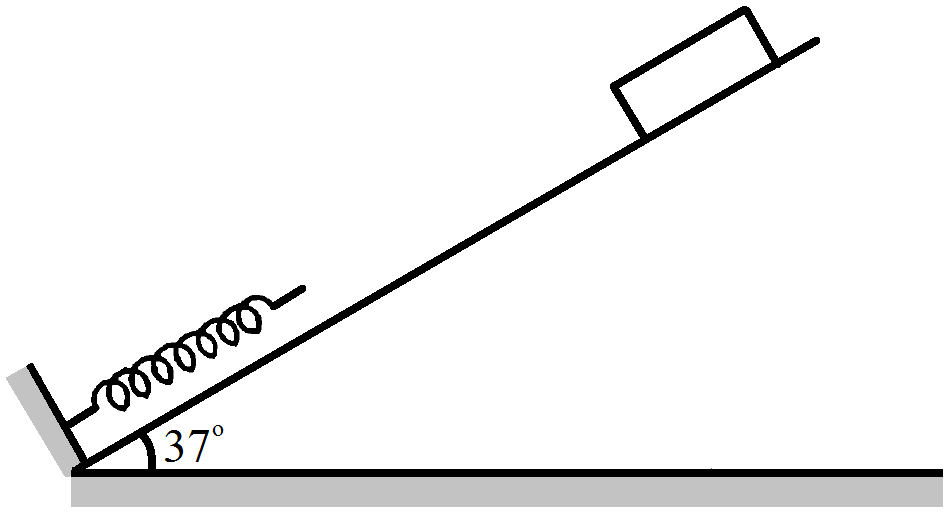
Figure shows a spring fixed at the bottom end of an incline of inclination 37°. A small block of mass 2kg starts slipping down the incline from a point 4.8m away from the spring. The block compresses the spring by 20cm, stops momentarily and then rebounds through a distance of 1m up the incline. Find.
  1. The friction coefficient between the plane and the block.
  2. The spring constant of the spring. Take g = 10m/s2.

Derive the equation of the missing term in the Ampere circuital law OR Derive the equation of displacement current and write its unit and definition.
  1. Derive Snell's law on the basis of Huygen's wave theory when light is travelling from a denser to a rarer medium.
  2. Draw the sketches to differentiate between plane wavefront and spherical wavefront.
Calculate the temperature at which the resistance of a conductor becomes 20% more than its resistance at 27°C. The value of the temperature coefficient of resistance of the conductor is $2.0 \times 10\frac{-4}{\text{K}}.$
Using Bohr's total postulates, derive the expression for the total energy of the electron in the stationary states of hydrogen atom.
Draw a plot showing the variation of power of a lens with the wavelength of the incident light.