MCQ
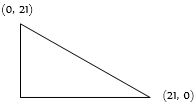
The number of integral points (integral point means both the coordinates should be integer) exactly in the interior of the triangle with vertices $(0, 0), (0, 21)$ and $(21, 0)$, is
  • A
    $133$
  • $190$
  • C
    $233$
  • D
    $105$

Answer

Correct option: B.
$190$
b
(b) $x + y = 21$
The number of integral solutions to the equation $x + y < 21$ i.e., $x < 21 - y$
$\therefore$  Number of integral co-ordinate
$ = 19 + 18 + .... + 1 = \frac{{19 \times 20}}{2} = 190$.

Need a full question paper?

Generate a complete, print-ready paper with questions like this in minutes — across 16+ boards, with answer keys.

Start Generating Free

Similar questions

A line through $(0,0)$ cuts the circle ${x^2} + {y^2} - 2ax = 0$ at $A$ and $B$, then locus of the centre of the circle drawn on $AB$ as a diameter is
$\frac{{{1^3} + {2^3} + {3^3} + {4^3} + {{........12}^3}}}{{{1^2} + {2^2} + {3^2} + {4^2} + {{.........12}^2}}} = $
The point of intersection of tangents at the ends of the latus-rectum of the parabola ${y^2} = 4x$ is equal to
If a variable line, $3x + 4y -\lambda  = 0$ is such that the two circles $x^2 + y^2 -2x -2y + 1 = 0$ and $x^2 + y^2 -18x -2y + 78 = 0$ are on its opposite sides, then the set of all values of $\lambda $ is the interval
Choose the correct answer. If $x^n- 1$ is divisible by $x - k,$ then the least positive integral value of $k$ is:
The curve described parametrically by $x = {t^2} + t + 1$, $y = {t^2} - t + 1$ represents
Let $S=\left[-\pi, \frac{\pi}{2}\right)-\left\{-\frac{\pi}{2},-\frac{\pi}{4},-\frac{3 \pi}{4}, \frac{\pi}{4}\right\}$. Then the number of elements in the set $=\{\theta \in S : \tan \theta(1+\sqrt{5} \tan (2 \theta))=\sqrt{5}-\tan (2 \theta)\}$ is $...$
Two fair dice are tossed. Let $A$ be the event that the first die shows an even number and $B$ be the event that the second die shows an odd number. The two event $A$ and $B$ are
If $x$ is real, then the maximum and minimum values of expression $\frac{{{x^2} + 14x + 9}}{{{x^2} + 2x + 3}}$ will be
If $a = \cos (2\pi /7) + i\,\sin (2\pi /7),$ then the quadratic equation whose roots are $\alpha = a + {a^2} + {a^4}$ and $\beta = {a^3} + {a^5} + {a^6}$ is