MCQ
The number of integral values of $'k'$ for which the equation $3 \sin x+4 \cos x=k+1$ has a solution, $k$ $\in R$ is
  • $11$
  • B
    $22$
  • C
    $33$
  • D
    $7$

Answer

Correct option: A.
$11$
a
$3 \sin x+4 \cos x=k+1$

$\Rightarrow k +1 \in\left[-\sqrt{3^{2}+4^{2}}, \sqrt{3^{2}+4^{2}}\right]$

$\Rightarrow k +1 \in[-5,5]$

$\Rightarrow k \in[-6,4]$

No. of integral values of $k =11$

Need a full question paper?

Generate a complete, print-ready paper with questions like this in minutes — across 16+ boards, with answer keys.

Start Generating Free

Similar questions

Let $f(x)=\cos 5 x+A \cos 4 x+B \cos 3 x$ $+C \cos 2 x+D \cos x+E$, and

$T=f(0)-f\left(\frac{\pi}{5}\right)+f\left(\frac{2 \pi}{5}\right)-f\left(\frac{3 \pi}{5}\right)+\ldots+f\left(\frac{8 \pi}{5}\right)-f\left(\frac{9 \pi}{5}\right) \text {. }$Then, $T$
The period of $f(x) = \sin \left( {\frac{{\pi x}}{{n - 1}}} \right) + \cos \,\left( {\frac{{\pi x}}{n}} \right)\,\,,\,n \in Z$, $n > 2$ is
Let $n$ be the number of ways in which $5$ boys and $5$ girls can stand in a queue in such a way that all the girls stand consecutively in the queue. Let $m$ be the number of ways in which $5$ boys and $5$ girls can stand in a queue in such a way that exactly four girls stand consecutively in the queue. Then the value of $\frac{m}{n}$ is
$p^{th}$ term of the series $\left( {3 - \frac{1}{n}} \right) + \left( {3 - \frac{2}{n}} \right) + \left( {3 - \frac{3}{n}} \right) + ....$ will be
The sum of $10$ terms of the series $\frac{3}{1^{2} \times 2^{2}}+\frac{5}{2^{2} \times 3^{2}}+\frac{7}{3^{2} \times 4^{2}}+\ldots$ is :
A batsman scores runs in 10 innings as 38, 70, 48, 34, 42, 55, 63, 46, 54 and 44. The mean deviation about mean is:
Find the equation of line parallel to x-axis and passing through (3, 4):
Choose the correct answer. If A lies in the second quadrant and $3\tan\text{A}+4=0,$ then the value of $2\cot\text{A}-5\cos\text{A}+\sin\text{A}$ is equal to:
$\mathop {\lim }\limits_{x \to 0} \frac{{{{\sin }^{ - 1}}x - {{\tan }^{ - 1}}x}}{{{x^3}}}$ is equal to
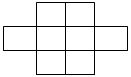
Six $‘X'$ s have to be placed in the square of the figure such that each row contains at least one $X$. In how many different ways can this be done