MCQ
The only liquid metal at the room temperature :
  • A
    Francium
  • B
    Sodium
  • Mercury
  • D
    Cobalt

Answer

Correct option: C.
Mercury

Need a full question paper?

Generate a complete, print-ready paper with questions like this in minutes — across 16+ boards, with answer keys.
Start Generating Free

Similar questions

Magnification produced by a convex mirror is always :
The pH of a sample of water collected from a river is found to be in the range of 3.5 to 4.5. The most likely reason for this is the waste being discharged into the river from a:
Organisms of a higher trophic level which feed on several types of organisms belonging to a number of lower trophic levels constitute the :
In an attempt to demonstrate electrical conductivity through an electrolyte, the following apparatus figure, was set up. Which among the following statement $(s)$ is $($are$)$ correct?
  1. Bulb will not glow because electrolyte is not acidic.
  2. Bulb will glow because $\ce{NaOH}$ is a strong base and furnishes ions for conduction.
  3. Bulb will not glow because circuit is incomplete.
  4. Bulb will not glow because it depends upon the type of electrolytic solution.
A student sitting on the last bench in the class cannot read the writing on the blackboard clearly but he can read the book lying on his de clearly. Which of the following statement is correct about the student?
A solution turns blue litmus red. Its $\ce{pH}$ is likely to be :
Which of the following statements are true for flowers?
  1. Flowers are always bisexual.
  2. They are the sexual reproductive organs.
  3. They are produced in all groups of plants.
  4. After fertilisation they give rise to fruits.
Which is the target organ of both adrenaline and insulin?
Following are certain reflex actions occurring in our body.
  • Moving to the side of road when a speeding car approaches.
  • Closing of eyes in response to a sudden bright light.
  • Shouting when we are suddenly disturbed or get scared.
  • Withdrawing hands on touching a hot surface. The reflex is given below, will be occurring for.
Receptors $($sense organs$)\ \xrightarrow[\text{Neurons}]{\text{Sensory}}\text{Spinal cord}\xrightarrow[\text{Neurons}]{\text{Motor}}$ targets/ effectors.
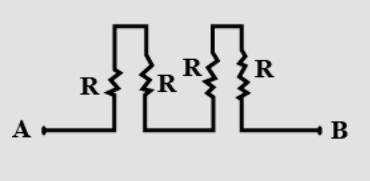
Four identical wires each having resistance $R$ are connected as shown in the figure. Equivalent resistance between $A$ and $B$ is :