Question

✓
Answer
- (d) $\psi^2$
- (b) Two
- (a) Hund’s Rule of Maximum Multiplicity rule
- (a)Lowest, Higher
Need a full question paper?
Generate a complete, print-ready paper with questions like this in minutes — across 16+ boards, with answer keys.
Explore more
Similar questions
Read the passage given below and answer the following questions from 1 to 5.
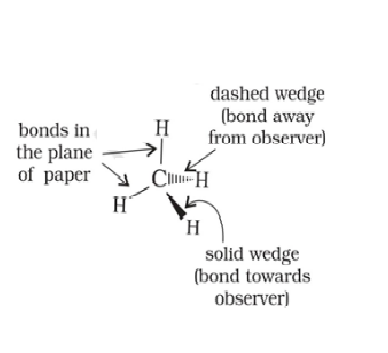
The three-dimensional (3-D) structure of organic molecules can be represented on paper by using certain conventions. For example, by using solid ( ) and dashed ( ) wedge formula, the 3-D image of a molecule from a two-dimensional picture can be perceived. In these formulas the solid-wedge is used to indicate a bond projecting out of the plane of paper, towards the observer. The dashed-wedge is used to depict the bond projecting out of the plane of the paper and away from the observer. Wedges are shown in such a way that the broad end of the wedge is towards the observer. The bonds lying in plane of the paper are depicted by using a normal line (—). 3-D representation of methane molecule on paper has been shown in Figure.
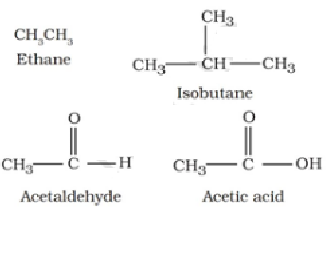
A cyclic or open chain componds these compounds are also called as aliphatic componds and consist of staright or branched chain componds for example:
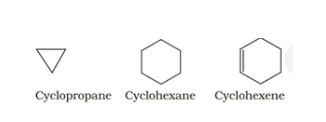
Cyclic or closed chain or ring compounds
a) Alicyclic compounds Alicyclic (aliphatic cyclic) compounds contain carbon atoms joined in the form of a ring (homocyclic).
Someetimes atoms other than carbon are also present in the ring (heterocylic). Tetrahydrofuran given below is an example of this types of compound:
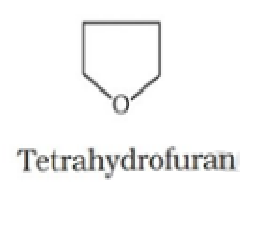
These exhibit some of the properties similar to those of aliphatic compounds.
b) Aromatic compounds Aromatic compounds are special types of compounds. These include benzene and other related ring compounds (benzenoid). Like alicyclic compounds, aromatic comounds may also have hetero atom in the ring. Such compounds are called hetrocyclic aromatic compounds. Some of the examples of various types of aromatic compounds are:
Benzenoid aromatic compounds .
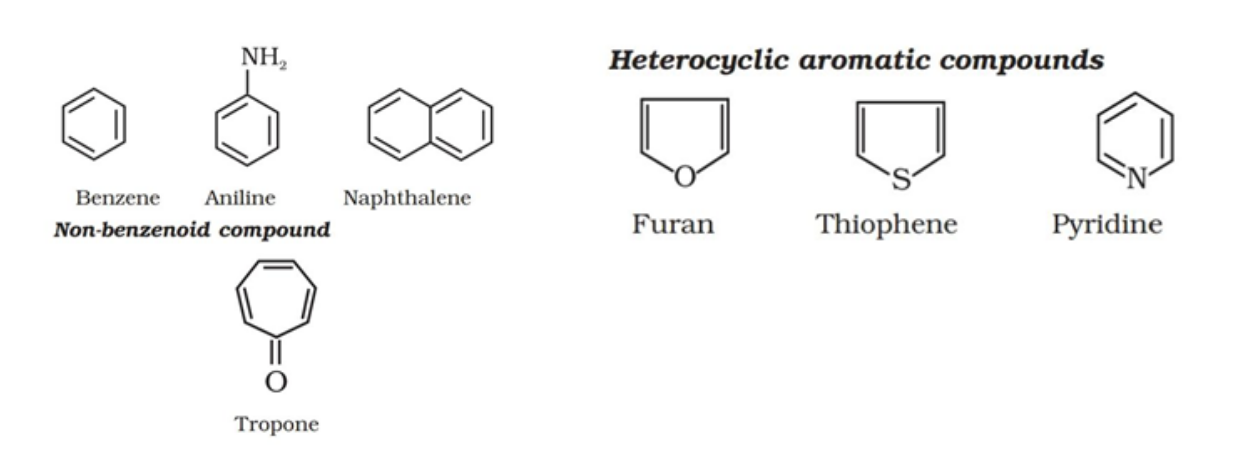
Organic compounds can also be classified on the basis of functional groups, into families or homologous series.
Functional Group The functional group is an atom or a group of atoms joined to the carbon chain which is responsible for the characteristic chemical properties of the organic compounds. The examples are hydroxyl group (–OH), aldehyde group (–CHO) and carboxylic acid group (–COOH) etc.
Homologous Series A group or a series of organic compounds each containing a characteristic functional group forms a homologous series and the members of the series are called homologues. The members of a homologous series can be represented by general molecular formula and the successive members differ from each other in molecular formula by a –CH2 unit. There are a number of homologous series of organic compounds. Some of these are alkanes, alkenes, alkynes, haloalkanes, alkanols, alkanals, alkanones, alkanoic acids, amines etc. It is also possible that a compound contains two or more identical or different functional groups. This gives rise to polyfunctional compounds.
A systematic name of an organic compound is generally derived by identifying the parent hydrocarbon and the functional group(s) attached to it. See the example given below.
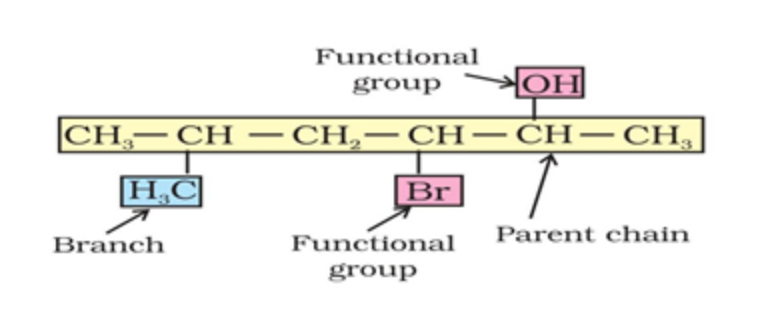
By further using prefixes and suffixes, the parent name can be modified to obtain the actual name. Compounds containing carbon and hydrogen only are called hydrocarbons. A hydrocarbon is termed saturated if it contains only carbon-carbon single bonds.
The IUPAC name for a homologous series of such compounds is alkane. Paraffin (Latin: little affinity) was the earlier name given to these compounds. Unsaturated hydrocarbons are those, which contain at least one carbon- carbon double or triple bond. IUPAC Nomenclature of Alkanes Straight chain hydrocarbons: The names of such compounds are based on their chain structure, and end with suffix ‘-ane’ and carry a prefix indicating the number of carbon atoms present in the chain (except from CH4 to C4H10, where the prefixes are derived from trivial names). The IUPAC names of some straight chain saturated hydrocarbons are given in Table. The alkanes in table differ from each other by merely the number of – CH2 groups in the chain. They are homologues of alkane series.
| Name | Molecular formula | Name | Molecular Formula |
| Methane | CH4 | Heptane | C7H16 |
| Ethane | C2H6 | Octane | C8H18 |
| Propane | C3H8 | Nonane | C9H20 |
| Butane | C4H10 | Decane | C10H22 |
| Pentane | C5H12 | Icosane | C20H42 |
| Hexane | C6H14 | Triacontane | C30H62 |
- IUPAC is an acronym for …
- International Union of Pure and Applied Chemistry
- International units of proteins and carbohydrates
- International understandings on physical aspects of chemistry
- Iodine under packings
- In homologous series, the successive members differ from each other in molecular formula by a … unit.
- CH3
- CH2
- CH
- CH4
- A hydrocarbon is termed saturated if it contains only carbon-carbon … bonds.
- Triple
- Double
- Single
- Zero
- From ….., where the prefixes are derived from… trivial names.
- CH4 to C2H6
- CH4 to C3H8
- CH4 to C6H14
- CH4 to C4H10
- Molecular formula of octane is …
- C4H10
- C6H14
- C2H6
- C8H18
Read the passage given below and answer the following questions from 1 to 5.
Quantitative measurement of properties isreaquired for scientific investigation. Earlier, two different systems of measurement, i.e., the English System and the Metric System were being used indifferent parts of the world. The metric system, which originated in France in late eighteenth century. The SI system has seven base units. these are listed as follow.
Here , Mass of a substance is the amount of matter present in it, while weight is the force exerted by gravity on an object. Density of a substance is its amount of mass per unit volume. The mole, symbol mol, is the SI unit of amount of substance. One mole contains exactly 6.02214076 × 10²³ elementary entities. This number is the fixed numerical value of the Avogadro constant, NA, when expressed in the unit per moland is called the Avogadro number. The amount of substance, symbol n, of a system is a measure of the number of specified elementary entities. An elementary entity may be an atom, a molecule, an ion, an electron, any other particle or specified group of particles.There are three common scales to measure temperature — °C (degree celsius), °F (degree fahrenheit) and K (kelvin). Here, K is the SIunit. Generally, the thermometer with celsius scale are calibrated from 0° to 100°, where these two temperatures are the freezing point and the boiling point of water, respectively. The fahrenheit scale is represented between 32° to 212°.
The temperatures on two scales are related to each other by the following relationship:
°F = 9 (°C) + 32
5
The kelvin scale is related to celsius scaleas follows:
K = °C + 273.15
Quantitative measurement of properties isreaquired for scientific investigation. Earlier, two different systems of measurement, i.e., the English System and the Metric System were being used indifferent parts of the world. The metric system, which originated in France in late eighteenth century. The SI system has seven base units. these are listed as follow.
| | Base Physical Quantities | Unit |
| 1 | Length | Metre – m |
| 2 | Mass | Kilogram – kg |
| 3 | Time | Second – s |
| 4 | Electric current | Ampere- A |
| 5 | Thermodynamic Temperature | Kelvin – K |
| 6 | Amount of substance | Mole – mol |
| 7 | Luminous intensity | Candela- cd |
The temperatures on two scales are related to each other by the following relationship:
°F = 9 (°C) + 32
5
The kelvin scale is related to celsius scaleas follows:
K = °C + 273.15
- The metric system,which originated in … in late eighteenthcentury.
- Ukraine
- German
- Russia
- France
- The SI system has …. base units.
- 7
- 3
- 9
- 1
- The symbol for SI unit of thermodynamic temperature is …
- Kelvin
- K
- Degree Celsius
- °C
- A prefix giga equivalents to:
- 109
- 1010
- 1011
- 1012
- The fahrenheit scale is represented between..
- 0°F to 100°F
- 32°F to 212°.F
- 15° F to 373° F
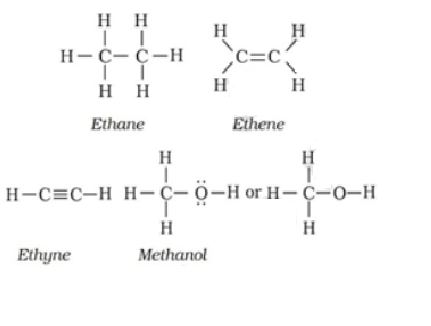
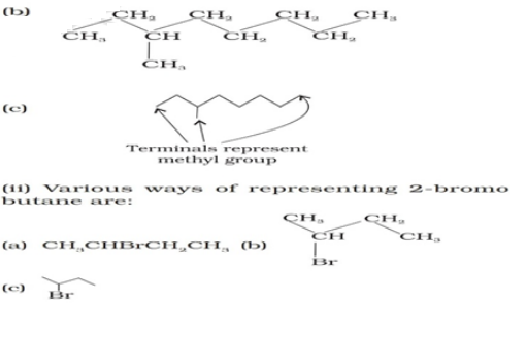
When anions and cations approach each other, the valence shell of anions are pulled towards the cation nucleus and thus, the shape of the anion is deformed. The phenomenon of deformation of anion by a cation is known as polarization and the ability of the cation to polarize the anion is called as polarizing power of cation. Due to polarization, sharing of electrons occurs between two ions to some extent and the bond shows some covalent character.
The magnitude of polarization depends upon a number of factors.
1. Out of $AlCl _3$ and $AlI _3$ which halides show maximum polarization? (1)
2. Out of $AlCl _3$ and $CaCl _2$ which one is more covalent in nature? (1)
3. The non-aqueous solvent like ether is added to the mixture of $LiCl , NaCl$ and KCl . Which will be extracted into the ether? (2)
OR
Out of $CaF _2$ and $CaI _2$ which one has a minimum melting point? (2)
→The magnitude of polarization depends upon a number of factors.
1. Out of $AlCl _3$ and $AlI _3$ which halides show maximum polarization? (1)
2. Out of $AlCl _3$ and $CaCl _2$ which one is more covalent in nature? (1)
3. The non-aqueous solvent like ether is added to the mixture of $LiCl , NaCl$ and KCl . Which will be extracted into the ether? (2)
OR
Out of $CaF _2$ and $CaI _2$ which one has a minimum melting point? (2)
Read the passage given below and answer the following questions from (i) to (v).
When covalent bond is formed betweentwo similar atoms, for example in H2,O2, Cl2,N2Or F2, the shared pair of electrons is equally Attracted by the two atoms. As a result electronPair is situated exactly between the twoIdentical nuclei. The bond so formed is calledNonpolar covalent bond. As a result of polarisation, the moleculePossesses the dipole moment which can be defined as the productOf the magnitude of the charge and theDistance between the centres of positive andNegative charge. It is usually designated by aGreek letter ‘µ’. Mathematically, it is expressedAs follows :Dipole moment (µ) = charge (Q) × distance ofSeparationDipole moment is usually expressed inDebye units (D). The conversion factor is1 D = 3.33564×10⁻³⁰ C mWhere C is coulomb and m is meter. Just as all the covalent bonds haveSome partial ionic character, the ionicBonds also have partial covalentCharacter. The partial covalent character of ionic bonds was discussed by Fajans in terms of the following rules:
When covalent bond is formed betweentwo similar atoms, for example in H2,O2, Cl2,N2Or F2, the shared pair of electrons is equally Attracted by the two atoms. As a result electronPair is situated exactly between the twoIdentical nuclei. The bond so formed is calledNonpolar covalent bond. As a result of polarisation, the moleculePossesses the dipole moment which can be defined as the productOf the magnitude of the charge and theDistance between the centres of positive andNegative charge. It is usually designated by aGreek letter ‘µ’. Mathematically, it is expressedAs follows :Dipole moment (µ) = charge (Q) × distance ofSeparationDipole moment is usually expressed inDebye units (D). The conversion factor is1 D = 3.33564×10⁻³⁰ C mWhere C is coulomb and m is meter. Just as all the covalent bonds haveSome partial ionic character, the ionicBonds also have partial covalentCharacter. The partial covalent character of ionic bonds was discussed by Fajans in terms of the following rules:
- The smaller the size of the cation and theLarger the size of the anion, the greater theCovalent character of an ionic bond.
- The greater the charge on the cation, theGreater the covalent character of the ionic bond.
- For cations of the same size and charge,The one, with electronic configuration(n-1)d0ns0, typical of transition metals, isMore polarising than the one with a nobleGas configuration, ns2 np6, typical of alkali and alkaline earth metal cations.
- The shape of a molecule depends uponThe number of valence shell electron pairs(bonded or nonbonded) around the centralAtom.
- Pairs of electrons in the valence shell repelone another since their electron clouds arenegatively charged.
- These pairs of electrons tend to occupySuch positions in space that minimiseRepulsion and thus maximise distanceBetween them.
- The valence shell is taken as a sphere withThe electron pairs localising on theSpherical surface at maximum distanceFrom one another.
- A multiple bond is treated as if it is a singleElectron pair and the two or three electronPairs of a multiple bond are treated as aSingle super pair.
- Where two or more resonance structuresCan represent a molecule, the VSEPRModel is applicable to any such structure.
- Dipole moment is usually expressed in….
- Debye
- Centimeter
- Columbs
- Ergs
- 1D = .....
- 33564×10–28Cm
- 3.3564×10⁻³⁰Cm
- 33564×10–32Cm
- 33564×10–34Cm
- Valence bond theory was introduced by ….
- Pauling and lewis
- Nyholm and Gillespie
- Heitler and London
- Sidgwick and Powell
- Pair is situated exactly between the two Identical nuclei the bond so formed is called …. covalent bond.
- Unipolar
- Bipolar
- Polar
- Nonpolar
- Pairs of electrons in the valence shell … one another since their electron clouds are negatively charged.
- Attract
- Repel
- Both a) & b)
- None if above
Read the passage given below and answer the following questions from (i) to (v).
The presence of positive charge on thenucleus is due to the protons in the nucleus.As established earlier, the charge on the proton is equal but opposite to that of electron.Atomic number (Z) = number of protons inthe nucleus of an atom = number of electrons in a nuetral atom. protons and neutrons present in thenucleus are collectively known as nucleons.The total number of nucleons is termed asmass number (A) of the atom.
mass number (A) = number of protons (Z) + number of neutrons (n).
Isobars are the atoms with same massnumber but different atomic number forexample, 64C and 714N. On the other hand, atomswith identical atomic number but differentatomic mass number are known as Isotopes.For example,considering of hydrogen atom again, 99.985% of hydrogen atoms contain only one proton.This isotope is called protium (11H). Rest of thepercentage of hydrogen atom contains two otherisotopes, the one containing 1 proton and 1neutron is called deuterium (21D, 0.015%)and the other one possessing 1 proton and 2neutrons is called tritium (13T )..the studiesof interactions of radiations with matter haveprovided immense information regarding thestructure of atoms and molecules. Neils Bohrutilised these results to improve upon themodel proposed by Rutherford. Twodevelopments played a major role in theformulation of Bohr’s model of atom. Thesewere:
$\text{c}=\text{v}\lambda$
The other commonly used quantityspecially in spectroscopy, is the wavenumber.It is defined as the number of wavelengthsper unit length. Its units are reciprocal ofwavelength unit, i.e., m–1. However commonlyused unit is cm–1
→The presence of positive charge on thenucleus is due to the protons in the nucleus.As established earlier, the charge on the proton is equal but opposite to that of electron.Atomic number (Z) = number of protons inthe nucleus of an atom = number of electrons in a nuetral atom. protons and neutrons present in thenucleus are collectively known as nucleons.The total number of nucleons is termed asmass number (A) of the atom.
mass number (A) = number of protons (Z) + number of neutrons (n).
Isobars are the atoms with same massnumber but different atomic number forexample, 64C and 714N. On the other hand, atomswith identical atomic number but differentatomic mass number are known as Isotopes.For example,considering of hydrogen atom again, 99.985% of hydrogen atoms contain only one proton.This isotope is called protium (11H). Rest of thepercentage of hydrogen atom contains two otherisotopes, the one containing 1 proton and 1neutron is called deuterium (21D, 0.015%)and the other one possessing 1 proton and 2neutrons is called tritium (13T )..the studiesof interactions of radiations with matter haveprovided immense information regarding thestructure of atoms and molecules. Neils Bohrutilised these results to improve upon themodel proposed by Rutherford. Twodevelopments played a major role in theformulation of Bohr’s model of atom. Thesewere:
- Dual character of the electromagneticradiation which means that radiations possess both wave like and particle likeproperties, and
- Experimental results regarding atomicspectra.
$\text{c}=\text{v}\lambda$
The other commonly used quantityspecially in spectroscopy, is the wavenumber.It is defined as the number of wavelengthsper unit length. Its units are reciprocal ofwavelength unit, i.e., m–1. However commonlyused unit is cm–1
- The presence of positive charge on the nucleus is due to the …. in the nucleus.
- Protons
- Neutrons
- Electron
- Nucleons
- Atomic Number is denoted by:
- A
- Z
- N
- M
- Atomic Mass number is denoted by:
- M
- Z
- N
- A
- … are the atoms with same mass number but different atomic number.
- Isotopes
- Allotropes
- Isobars
- None of above
- Atoms with identical atomic number but different atomic mass number are known as ..
- Isotopes
- Allotropes
- Isobars
- None of above
We must bear in mind that when Mendeleev developed his Periodic Table, chemists knew nothing about the internal structure of atom. However, the beginning of the 20th century witnessed profound developments in theories about sub-atomic particles. In 1913, the English physicist, Henry Moseley observed regularities in the characteristic X-ray spectra of the elements. A plot of ν (whereν is frequency of X-rays emitted) against atomic number (Z ) gave a straight line and not the plot of ν vs atomic mass. He thereby showed that the atomic number is a more fundamental property of an element than its atomic mass. Mendeleev’s Periodic Law was, therefore, accordingly modified. This is known as the Modern Periodic Law and can be stated as : The physical and chemical properties of the elements are periodic functions of their atomic numbers.Numerous forms of Periodic Table have been devised from time to time. Some forms emphasise chemical reactions and valence, whereas others stress the electronic configuration of elements. A modern version, the so-called “long form” of the Periodic Table of the elements , is the most convenient and widely used. The horizontal rows (which Mendeleev called series) are called periods and the vertical columns, groups. Elements having similar outer electronic configurations in their atoms are arranged in vertical columns, referred to as groups or families. According to the recommendation of International Union of Pure and Applied Chemistry (IUPAC), the groups are numbered from 1 to 18 replacing the older notation of groups IA … VIIA, VIII, IB … VIIB and 0. There are altogether seven periods. The period number corresponds to the highest principal quantum number (n) of the elements in the period. The first period contains 2 elements. The subsequent periods consists of 8, 8, 18, 18 and 32 elements, respectively. The seventh period is incomplete and like the sixth period would have a theoretical maximum (on the basis of quantum numbers) of 32 elements. In this form of the Periodic Table, 14 elements of both sixth and seventh periods (lanthanoids and actinoids, respectively) are placed in separate panels at the bottom. the IUPAC has made recommendation that until a new element’s discovery is proved, and its name is officially recognised, a systematic nomenclature be derived directly from the atomic number of the element using the numerical roots for 0 and numbers 1-9. The roots are put together in order of digits which make up the atomic number and “ium” is added at the end.Groupwise Electronic Configurations Elements in the same vertical column or group have similar valence shell electronic configurations, the same number of electrons in the outer orbitals, and similar properties. theoretical foundation for the periodic classification. The elements in a vertical column of the Periodic Table constitute a group or family and exhibit similar chemical behaviour. This similarity arises because these elements have the same number and same distribution of electrons in their outermost orbitals. We can classify the elements into four blocks viz., s-block, p-block, d-block and f-block depending on the type of atomic orbitals that are being filled with electrons. Two exceptions to this categorisation. Strictly, helium belongs to the s-block but its positioning in the p-block along with other group 18 elements is justified because it has a completely filled valence shell (1s) and as a result, exhibits properties characteristic of other noble gases. The other exception is hydrogen. It has only one s-electron and hence can be placed in group 1 (alkali metals). It can also gain an electron to achieve a noble gas arrangement and hence it can behave similar to a group 17 (halogen family) elements. Because it is a special case, we shall place hydrogen separately at the top of the Periodic Table.
- In 1913, the English physicist, ….observed regularities in the characteristic X-ray spectra of the elements.
- Johann Dobereiner
- John Alexander Newlands
- Demitri Mendeleev
- Henry Moseley
- Horizontal row in periodic table called:
- Group
- Period
- Triad
- Octave
- Vertical Column in periodic table called:
- Group
- Period
- Triad
- Octave
- According to Modern Periodic Law the physical and chemical properties of the elements are periodic functions of their ….
- Atomic mass
- Atomic numbers
- Atomic structure
- Atomic size
- What is IUPAC name of element having atomic number 107.
- Unnilpentium
- Unnilhexium
- Unnilseptium
- Unniloctium
The molecular orbital theory is based on the principle of a linear combination of atomic orbitals. According to this approach when atomic orbitals of the atoms come closer, they undergo constructive interference as well as destructive interference giving molecular orbitals, i.e., two atomic orbitals overlap to form two molecular orbitals, one of which lies at a lower energy level (bonding molecular orbital). Each molecular orbital can hold one or two electrons in accordance with Pauli's exclusion principle and Hund's rule of maximum multiplicity.
For molecules up to $N _2$, the order of filling of orbitals is:

Bond order $=\frac{1}{2}$ [bonding electrons - antibonding electrons]
Bond order gives the following information:
I. If bond order is greater than zero, the molecule/ion exists otherwise not.
II. Higher the bond order, higher is the bond dissociation energy.
III. Higher the bond order, greater is the bond stability.
IV. Higher the bond order, shorter is the bond length.
1. Arrange the following negative stabilities of $CN , CN ^{+}$and $CN ^{-}$in increasing order of bond. (1)
2. The molecular orbital theory is preferred over valence bond theory. Why? (1)
3. Ethyne is acidic in nature in comparison to ethene and ethane. Why is it so? (2)
OR
Bonding molecular orbital is lowered by a greater amount of energy than the amount by which antibonding molecular orbital is raised. Is this statement correct? (2)
→→For molecules up to $N _2$, the order of filling of orbitals is:
Bond order $=\frac{1}{2}$ [bonding electrons - antibonding electrons]
Bond order gives the following information:
I. If bond order is greater than zero, the molecule/ion exists otherwise not.
II. Higher the bond order, higher is the bond dissociation energy.
III. Higher the bond order, greater is the bond stability.
IV. Higher the bond order, shorter is the bond length.
1. Arrange the following negative stabilities of $CN , CN ^{+}$and $CN ^{-}$in increasing order of bond. (1)
2. The molecular orbital theory is preferred over valence bond theory. Why? (1)
3. Ethyne is acidic in nature in comparison to ethene and ethane. Why is it so? (2)
OR
Bonding molecular orbital is lowered by a greater amount of energy than the amount by which antibonding molecular orbital is raised. Is this statement correct? (2)
Read the passage given below and answer the following questions from (i) to (iii). Le Chatelier’s principle is also known as the equilibrium law, used to predict the effect of change on a system at chemical equilibrium. This principle states that equilibrium adjusts the forward and backward reactions in such a way as to accept the change affecting the equilibrium condition. When factor-like concentration, pressure, temperature, inert gas that affect equilibrium are changed, the equilibrium will shift in that direction where the effects caused by these changes are nullified. This principle is also used to manipulate reversible reactions in order to obtain suitable outcomes.
→- Which one of the following conditions will favour the maximum formation of the product in the reaction?
$\text{A}_{2(\text{g})}+\text{B}_{2(\text{g})}\rightleftharpoons\text{X}_{2(\text{g})},\triangle_\text{r}\text{H}=-\text{XkJ}?$
- Low temperature and high pressure.
- Low temperature and low pressure.
- High temperature and high pressure.
- High temperature and low pressure.
- For the reversible reaction,
$\text{N}_{2(\text{g})}+3\text{H}_{2(\text{g})}\rightleftharpoons2\text{NH}_{3(\text{g})}+\text{heat}$
The equilibrium shifts in forwarding direction
- By increasing the concentration of NH3(g)
- By decreasing the pressure.
- By decreasing the concentrations of N2(g) and H2(g)
- By increasing pressure and decreasing temperature.
- In which one of the following equilibria will the point of equilibrium shift to left when the pressure of the system is increased?
- $\text{H}_{2(\text{g})}+\text{l}_{2(\text{g})}\rightleftharpoons2\text{HI}_{(\text{g})}$
- $2\text{NH}_{3(\text{g})}\rightleftharpoons\text{N}_{2(\text{g})}+3\text{H}_{2(\text{g})}$
- $\text{C}_{(\text{s})}+\text{O}_{2(\text{g})}\rightleftharpoons\text{CO}_{2{\text{g}}}$
- $2\text{H}_{2(\text{g})}+\text{O}_{2(\text{g})}\rightleftharpoons2\text{H}_2\text{O}_{(\text{g})}$