Question
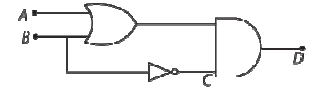
The output for the given, circuit is

Answer

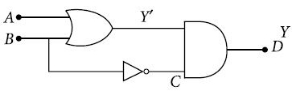
$(a)$ Here $Y^{\prime}=A+B$ and $Y=Y^{\prime} \cdot \bar{B}=(A+B) \cdot B$


Need a full question paper?

Generate a complete, print-ready paper with questions like this in minutes — across 16+ boards, with answer keys.
Start Generating Free

Similar questions

Two identical capacitors have same capacitance $C$. One of them is charged to the potential $\mathrm{V}$ and other to the potential $2 \mathrm{~V}$. The negative ends of both are connected together. When the positive ends are also joined together, the decrease in energy of the combined system is :
A $5\;ampere$ fuse wire can withstand a maximum power of $1\; watt$ in the circuit. The resistance of the fuse wire is
A monochromatic beam of light passes from a denser medium into a rarer medium. As a result
Part of the tuning arrangement of a radio consists of a wheel which is acted on by two parallel constant forces as shown in the fig. If the wheel rotates just once, the work done will be about (diameter of the wheel = $0.05\ m$)
Two protons exerts a nuclear force on each other, the distance between them is
A small soap bubble of radius $4\,cm$  is trapped inside another bubble of radius $6\,cm$ without any contact. Let $P_2$  be the pressure inside the inner bubble and $P_0$  the pressure outside the outer bubble. Radius of another bubble with pressure difference $P_2 - P_0$  between its inside and outside would be....... $cm$
An ideal coil of $10\, henry$ is joined in series with a resistance of $5 \,ohm$ and a battery of $5 \,volt$. $2$ second after joining, the current flowing in ampere in the circuit will be
For three vectors $\vec{A}=(-x \hat{i}-6 \hat{j}-2 \hat{k})$, $\vec{B}=(-\hat{i}+4 \hat{j}+3 \hat{k})$ and $\vec{C}=(-8 \hat{i}-\hat{j}+3 \hat{k})$, if $\overrightarrow{\mathrm{A}} \cdot(\overrightarrow{\mathrm{B}} \times \overrightarrow{\mathrm{C}})=0$, them value of $\mathrm{x}$ is. . . . . .. 
The stopping potential for electrons emitted from a photosensitive surface illuminated by light of wavelength $491\, nm$ is $0.710\, V$. When the incident wavelength is changed to a new value, the stopping potential is $1.43\, V$. The new wavelength is ....... $nm.$
In the network of resistors shown in the adjoining figure, the equivalent resistance between $A$ and $B$ is ............ $ohm$