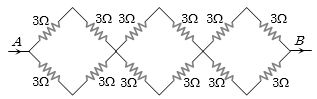
In the network of resistors shown in the adjoining figure, the equivalent resistance between $A$ and $B$ is ............ $ohm$
Medium



Download our appand get started for free
Experience the future of education. Simply download our apps or reach out to us for more information. Let's shape the future of learning together!No signup needed.*
Similar Questions
- 1A dry cell has an $e.m.f.$ of $1.5\, V$ and an internal resistance of $0.05\,\Omega $. The maximum current obtainable from this cell for a very short time interval is ................... $A$View Solution
- 2A cable of resistance $10\,\Omega $ carries electric power from a generator producing $250\, kW$ at $10000\, volt$, the power lost in the cable during transmission is ............. $kW$View Solution
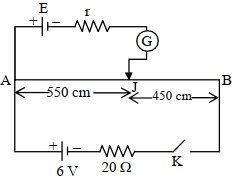
- 3In the given figure, there is a circuit of potentiometer of length $A B=10 \,{m}$. The resistance per unit length is $0.1 \,\Omega$ per ${cm}$. Across ${AB}$, a battery of emf ${E}$ and internal resistance ' ${r}^{\prime}$ is connected. The maximum value of emf measured by this potentiometer is : (In $V$)View Solution
- 4In previous problem, if the cell had been connected in parallel (instead of in series) which of the above graphs would have shown the relationship between total current $I$ and $n$?View Solution
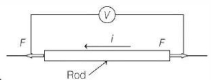
- 5As shown in the schematic below, a rod of uniform cross-sectional area $A$ and length $l$ is carrying a constant current $i$ through it and voltage across the rod is measured using an ideal voltmeter. The rod is stretched by the application of a force $F$. Which of the following graphs would show the variation in the voltage across the rod as function of the strain $\varepsilon$ when the strain is small. Neglect Joule heating.View Solution
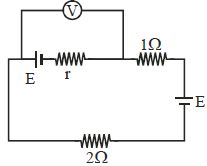
- 6In the given circuit reading of ideal voltmeter is $\frac{E}{2}$ then internal resistance of cell is ............. $\Omega$View Solution
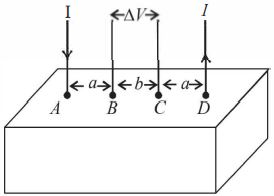
- 7Consider a block of conducting material ofresistivity '$\rho$' shown in the figure. Current '$I$' enters at '$A$' and leaves from '$D$'. We apply superp osition principle to find voltage '$\Delta V$ ' developed between '$B$' and '$C$'. The calculation is done in the following steps:View Solution
$(i)$ Take current '$I$' entering from '$A$' and assume it to spread over a hemispherical surface in the block.
$(ii)$ Calculatefield $E(r)$ at distance '$r$' from $A$ by using Ohm's law $E = \rho j$, where j is the current per unit area at '$r$'.
(iii) From the '$r$' dependence of $E(r)$, obtain the potential $V(r)$ at $r$.
(iv) Repeat $(i), (ii)$ and $(iii)$ for current '$I$' leaving '$D$' and superpose results for '$A$' and '$D$'.$\Delta V$ measured between $B$ and $C$ is
- 8View SolutionOf the two bulbs in a house hold circuit, one glows brighter than the other, Which of the two bulbs has a large resistance?
- 9A fuse wire with radius $1\, mm$ blows at $1.5\, amp$. The radius of the fuse wire of the same material to blow at $3\,A$ will beView Solution
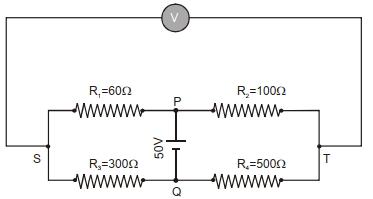
- 10In the balanced condition, the values of the resistances of the four arms of a Wheatstone bridge are shown in the figure below. The resistance $R_3$ has temperature coefficient $0.0004{ }^{\circ} C ^{-1}$. If the temperature of $R_3$ is increased by $100{ }^{\circ} C$, the voltage developed between $S$ and $T$ will be. . . . . . . volt.View Solution