MCQ
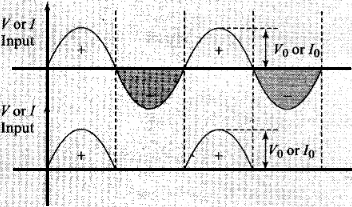
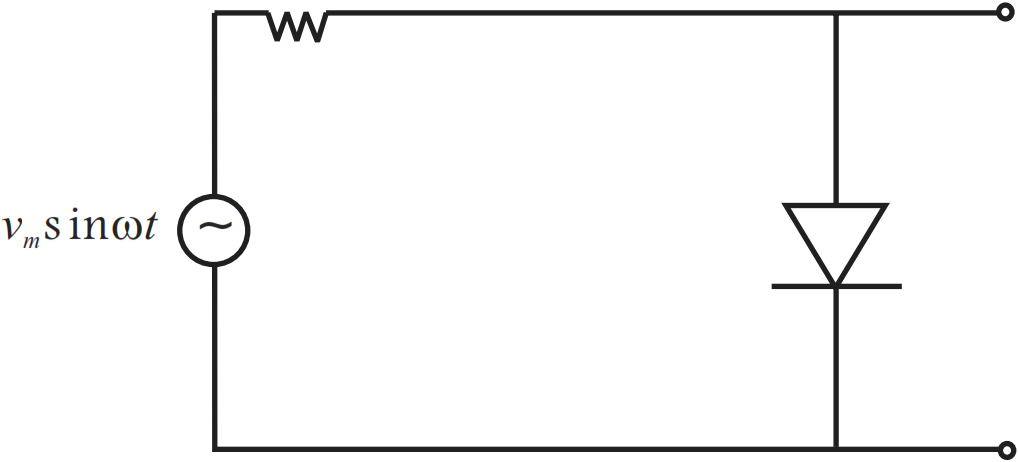
The output of the given circuit in Fig.
  • A
    Would be zero at all times.
  • B
    Would be like a half wave rectifier with positive cycles in output.
  • Would be like a half wave rectifier with negative cycles in output.
  • D
    Would be like that of a full wave rectifier.

Answer

Correct option: C.
Would be like a half wave rectifier with negative cycles in output.
Key Concept:
  1. During positive half cycle,
Diode $\rightarrow $ Forward biased
Output signal $\rightarrow $ obtained
  1. During negative half cycle,
Diode $\rightarrow $ reverse biased
Output signal $\rightarrow $ not obtained
  1. Output voltage is obtained across the load resistance $RL$. It is not constant but pulsating $($mixture of $ac$ and $dc)$ in nature.
  2. Average output in one cycle
  3. $\text{r.m.s.}$ output: $\text{I}_\text{rms}=\frac{\text{I}_0}{2},\text{V}_\text{rms}=\frac{\text{V}_0}{2}$
When the diode is forward biased during positive half cycle of input $AC$ voltage, the resistance of $p-n$ junction is low. The current in the circuit is maximum. In this situation, a maximum potential difference will appear across resistance connected in a series of circuit. This result into zero output voltage across $p-n$ junction.
And when the diode is reverse biased during negative half cycle of $AC$ voltage, the $p-n$ junction is reverse biased. The resistance of $p-n$ junction becomes high which will be more than resistance in series. That is why, there will be voltage across $p-n$ junction with negative cycle in output, hence option $(c)$ is correct.

Need a full question paper?

Generate a complete, print-ready paper with questions like this in minutes — across 16+ boards, with answer keys.

Start Generating Free

Similar questions

The $\beta$-decay process, discovered around $1900$ , is basically the decay of a neutron ( $n$ ), In the laboratory, a proton ( $p$ ) and an electron ( $e ^{-}$) are observed as the decay products of the neutron. therefore, considering the decay of a neutron as a tro-body dcay process, it was predicted theoretically that thekinetic energy of the electron should be a constant. But experimentally, it was observed that the electron kinetic energy has a continuous spectrum. Considering a three-body decay process, i.e. $n \rightarrow p+ e ^{-}+\bar{v}_{ e }$, around $1930,$ Pauli explained the observed electron energy spectrum. Assuming the anti-neutrino $\left(\bar{v}_{ e }\right)$ to be massless and possessing negligible energy, and neutron to be at rest, momentum and energy conservation principles are applied. From this calculation, the maximum kinetic energy of the lectron is $0.8 \times 10^6 eV$. The kinetic energy carried by the proton is only the recoil energy.

$1.$ What is the maximum energy of the anti-neutrino?

$(A)$ Zero

$(B)$ Much less than $0.8 \times 10^6 \ eV$

$(C)$ Nearly $0.8 \times 10^6 \ eV$

$(D)$ Much larger than $0.8 \times 10^6 \ eV$

$2.$ If the anti-neutrino had a mass of $3 eV / c ^2$ (where $c$ is the speed of light) instead of zero mass, what should be the range of the kinetic energy, $K$, of the electron?

$(A)$ $0 \leq K \leq 0.8 \times 10^6 \ eV$

$(B)$ $3.0 eV \leq K \leq 0.8 \times 10^6 \ eV$

$(C)$ $3.0 eV \leq K < 0.8 \times 10^6 \ eV$

$(D)$ $0 \leq K < 0.8 \times 10^6 \ eV$

Give the answer question $1$ and $2.$
Force of attraction between two point charges $Q$ and $-Q$ separated by $d\,$ metre is ${F_e}$. When these charges are placed on two identical spheres of radius $R = 0.3\,d$ whose centres are $d\,$ metre apart, the force of attraction between them is
The particles which can be added to the nucleus of an atom without changing its chemical properties are called
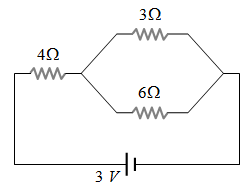
The potential drop across the 3W resistor is
A long magnet is cut in two parts in such a way that the ratio of their lengths is 2 : 1. The ratio of pole strengths of both the section is
Assertion : Soft and hard $X-$ rays differ in frequency as well as velocity.
Reason : The penetrating power of hard $X-$ rays is more than the penetrating power of soft $X-$ rays.
The temperature coefficient of resistance of a semiconductor
Penetrating power of $X$-rays increases with increase in
Which of the following is incorrect statement regarding photon
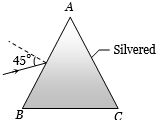
A prism $ABC$ of angle $30^o $ has its face $AC$ silvered. A ray of light incident at an angle of $45^o $ at the face $AB$ retraces its path after refraction at face $AB$ and reflection at face $AC$. The refractive index of the material of the prism is