MCQ
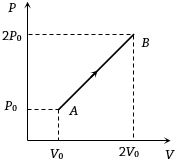
The $P-V$ diagram of $2$ gm of helium gas for a certain process $A \to B$ is shown in the figure. what is the heat given to the gas during the process $A \to B$
  • A
    $4{P_o}{V_o}$
  • $6{P_o}{V_o}$
  • C
    $4.5{P_o}{V_o}$
  • D
    $2{P_o}{V_o}$

Answer

Correct option: B.
$6{P_o}{V_o}$
b
(b) Change in internal energy from $A \to B$ is

$\Delta U = \frac{f}{2}\mu R\Delta T = \frac{f}{2}({P_f}{V_f} - {P_i}{V_i})$

$ = \frac{3}{2}(2{P_0} \times 2{V_0} - {P_0} \times {V_0}) = \frac{9}{2}{P_0}{V_0}$

Work done in process $A \to B$ is equal to the Area covered by the graph with volume axis i.e.,

${W_{A \to B}} = \frac{1}{2}({P_0} + 2{P_0}) \times (2{V_0} - {V_0}) = \frac{3}{2}{P_0}{V_0}$

Hence, $\Delta Q = \Delta U + \Delta W$$ = \frac{9}{2}{P_0}{V_0} + \frac{3}{2}{P_0}{V_0} = 6{P_0}{V_0}$

Need a full question paper?

Generate a complete, print-ready paper with questions like this in minutes — across 16+ boards, with answer keys.
Start Generating Free

Similar questions

$A$ ball of mass $m$ is attached to the lower end of light vertical spring of force constant $k$. The upper end of the spring is fixed. The ball is released from rest with the spring at its normal (unstretched) length, comes to rest again after descending through a distance $x.$
An object of mass $80 \,kg$ moving with velocity $2 \,ms ^{-1}$ hit by collides with another object of mass $20 \,kg$ moving with velocity $4 \,ms ^{-1}$. Find the loss of energy assuming a perfectly inelastic collision ........... $J$
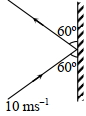
A body of mass $3\, kg$ hits a wall at an angle of $60^o$ and returns at the same angle. The impact time was $0.2 \;.s$ Calculate the force exerted on the wall
The potential energy for a conservative system is given by:

$U = ax^2 - bx$

Where $a$ and $b$ are positive constants. The law of the force governing the system is
A circular road of radius $1000 \,m$ has banking angle ${45^o}$. The maximum safe speed of a car having mass $2000 \,kg$ will be, if the coefficient of friction between tyre and road is $0.5$ ....... $m/s$
A man of mass $100\,kg$. is standing on a platform of mass $200\,kg$. which is kept on a smooth ice surface. If the man starts moving on the platform with a speed $30\,m / sec$ relative to the platform then calculate with what velocity relative to the ice the platform will recoil $..........m/s$
A diatomic gas $(\gamma=1.4)$ does $100 \mathrm{~J}$ of work in an isobaric expansion. The heat given to the gas is :
If a body describes a circular motion under inverse square field, the time taken to complete one revolution $T$ is related to the radius of the circular orbit as
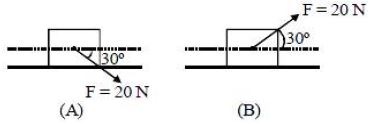
A block of mass $5\, kg$ is $(i)$ pushed in case $(A)$ and $(ii)$ pulled in case $(B)$, by a force $F = 20\, N$, making an angle of $30^o$ with the horizontal, as shown in the figures. The coefficient of friction between the block and floor is $\mu = 0.2$. The difference between the accelerations of the block, in case $(B)$ and case $(A)$ will be ........ $ms^{-2}$ .$(g = 10\, ms^{-2})$
A Carnot engine with sink's temperature at $17\,^oC$ has $50\%$ efficiency. By how much should its source temperature be changed to increases its efficiency to $60\%$ ?...... $K$