MCQ
The pair having the same dimensions is
  • A
    Angular momentum, work
  • Work, torque
  • C
    Potential energy, linear momentum
  • D
    Kinetic energy, velocity

Answer

Correct option: B.
Work, torque
b
(b) Dimension of work and torque = $[M{L^2}{T^{ - 2}}]$

Need a full question paper?

Generate a complete, print-ready paper with questions like this in minutes — across 16+ boards, with answer keys.
Start Generating Free

Similar questions

Two identical solid copper spheres of radius $R$ placed in contact with each other. The gravitational attracton between them is proportional to
A gas at $ 27\ ^oC$ has a volume $V$ and pressure $P$. On heating its pressure is doubled and volume becomes three times. The resulting temperature of the gas will be ....... $^oC$
During melting of a slab of ice at 273°K at atmospheric pressure:
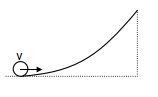
A small object of uniform density rolls up a curved surface with an initial velocity $v$. It reaches up to a maximum height of $\frac{3 \mathrm{v}^2}{4 \mathrm{~g}}$ with respect to the initial position. The object is
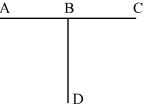
Three conducting rods of same material and cross-section are shown in figure. Temperatures of$ A, D$ and $C$ are maintained at $20^o C, 90^o C$ and $0^o C$. The ratio of lengths of $BD$ and $BC$ if there is no heat flow in $AB$ is:
The momentum $p$ (in $kg m / s )$ of a particle is varying with time $t$ (in $s )$ as $p=2+3 t^2$. The force acting on the particle at $t=3 s$ will be ......... $N$
The density and breaking stress of a wire are $6 \times$ $10^4 \mathrm{~kg} / \mathrm{m}^3$ and $1.2 \times 10^8 \mathrm{~N} / \mathrm{m}^2$ respectively. The wire is suspended from a rigid support on a planet where acceleration due to gravity is $\frac{1^{\text {rd }}}{3}$ of the value on the surface of earth. The maximum length of the wire with breaking is ............ $\mathrm{m}$ (take, $\mathrm{g}=$ $\left.10 \mathrm{~m} / \mathrm{s}^2\right)$
A wide vessel with a small hole at the bottom is filled with two liquids. The density and heightof one liquid are $\rho_1$ and $h_1$ and that of the otherare  $\rho_2$ and $h_2 \ (\rho_1 >\rho_2)$. The velocity of liquid coming out of the hole is :
The initial velocity of a particle is $u\left(\right.$ at $t=0$ ) and the acceleration a is given by $\alpha t^{3 / 2}$. Which of the following relations is valid?
Which of the following (if mass and radius are assumed to be same) have maximum percentage of total $K.E.$ in rotational form while pure rolling?