Question
The particle that possesses half integral spin as(a) Photon(b) Pion  (c) Proton(d) K-meson
       

Answer

(c) Proton

Need a full question paper?

Generate a complete, print-ready paper with questions like this in minutes — across 16+ boards, with answer keys.

Start Generating Free

Similar questions

Cathode rays enter into a uniform magnetic field perpendicular to the direction of the field. In the magnetic field their path will be(a) Straight line(b) Circle(c) Parabolic(d) Ellipse
       
If the wavelength of light in an experiment on photoelectric effect is doubled:
The electric potential at the surface of an atomic nucleus $(Z=50)$ of radius $9.0 \times 10^{-13} cm$ is
A hemisphere is uniformely charged positively. The electric field at a point on a diameter away from the centre is directed.
A compound lens has been manufactured by combining lenses of power +2.50 D and -3.75 D . The value of its focal length in cm will be :
A galaxy is observed to be moving with a velocity of $8600 \mathrm{~km}-\mathrm{sec}^{-1}$. If it is at a distance of $430$ million light year from us, Hubble constant and corresponding age of the universe are respectively
The light source will be coherent if :
In a double slit experiment, instead of taking slits of equal widths, one slit is made twice as wide as the other. Then in the interference pattern(a) The intensities of both the maxima and the minima increase  (b) The intensity of maxima increases and the minima has zero intensity (c) The intensity of maxima decreases and that of the minima increases(d) The intensity of maxima decreases and the minima has zero intensity


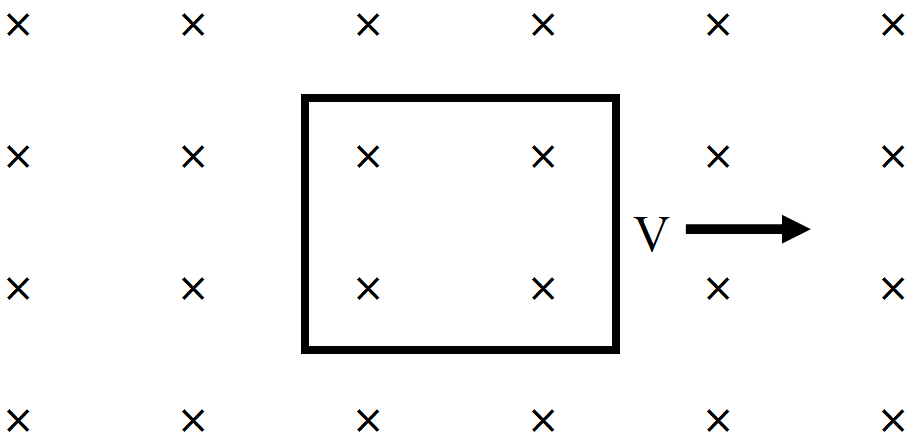
A conducting square loop of side l and resistance R moves in its plane with a uniform velocity u perpendicular to one of its sides. A uniform and constant magnetic field B exists along the perpendicular to the plane of the loop as shown in figure. The current induced in the loop is:
  1. $\frac{\text{Blv}}{\text{R}}$ clockwise.
  2. $\frac{\text{Blv}}{\text{R}}$ anticlockwise.
  3. $\frac{2\text{Blv}}{\text{R}}$ anticlockwise.
  4. $\text{Zero.}$
A photoelectric cell is a device which?